


The web was built for documents. A page has a URL, a title, some headings, some text. Search engines learned to rank those documents. Humans learned to click the links.
AI retrieval systems work differently. They do not rank documents — they extract claims, verify them against known entities, and synthesize answers. The unit of value is no longer the page. It is the verifiable assertion: a claim, its source, and the evidence that supports it.
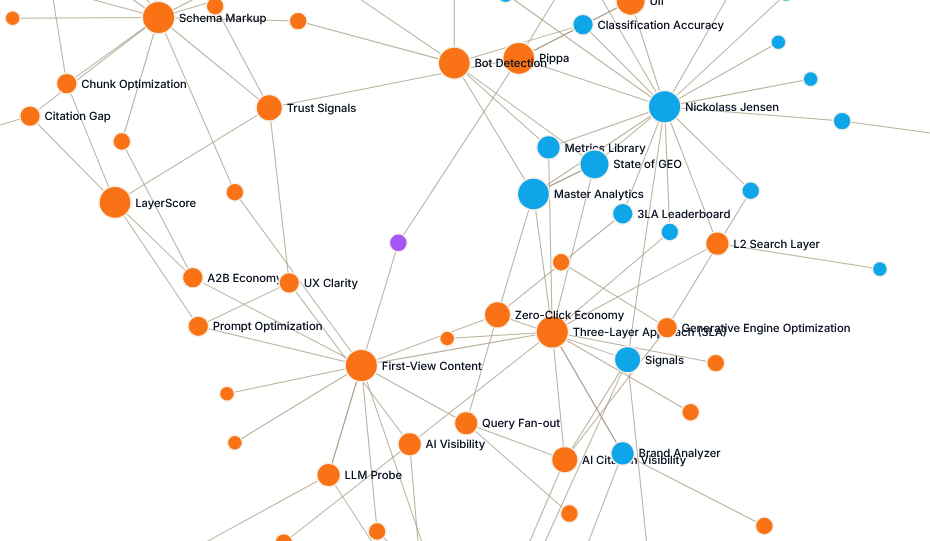
This is the shift the Three-Layer Approach (3LA) is built around. And on June 5, 2026, we published a page designed from the ground up to operate in that new regime: threelayerapproach.com/entitymap – an interactive knowledge graph mapping 87 entities and 128 relations across the entire 3LA ontology, with a machine-readable entitymap.json declared in the page <head> via <link rel="entitymap">.
By June 7 – 48 hours later – Google AI Mode was returning structurally accurate, multi-section responses about the page. Two distinct queries. Six and fourteen sources respectively. Both correct.
This article documents what happened, why it is consistent with the entity-first hypothesis, and where the evidence remains incomplete.
The Architecture: Document → Entity → Evidence
ChatGPT, in its evaluation of this article, identified what it called “the most interesting implicit model” in the entire piece:
Document → Entity → Evidence
That is: Document → Knowledge → Verifiable claim.
It is not a new idea. It is how modern RAG (Retrieval-Augmented Generation) systems actually work. When an AI retrieval system processes a query, it does not fetch a page and quote a paragraph. It identifies entities, maps their relationships, and traces claims back to evidence. A document that makes this structure explicit – rather than burying it in prose – reduces the inference load on the retrieval system.
That is what the entitymap page was built to do.

threelayerapproach.com/entitymap)The implementation has three layers:
Layer 1 — The interactive knowledge graph (threelayerapproach.com/entitymap) An SVG-rendered force-directed graph with 87 entity nodes (Knowledge, Actor, Temporal) and 128 typed relations. Drag to explore, click a node to read its definition and connections. Every core 3LA concept — LayerScore™, CFR, ACU, Dark Opportunities, First-View Content, Zero-Click Economy — is a named node with explicit edges.
Layer 2 — The JSON-LD DefinedTerm schema Every entity carries DefinedTerm markup with name, description, and inDefinedTermSet properties. This gives AI retrieval systems a pre-parsed ontology rather than prose to interpret.
Layer 3 — The entitymap.json file Declared in the page <head> as <link rel="entitymap" type="application/json" href="https://threelayerapproach.com/api/public/entitymap.json"> — following the EntityMap open standard specification exactly. A human-readable companion exists at threelayerapproach.com/entitymap.html.
The EntityMap standard itself is not a 3LA invention. Credit belongs to Dixon Jones — CEO of InLinks, co-founder of Waikay, author of Entity SEO – who initiated the open standard to give AI retrieval systems a structured, machine-readable declaration of what a website knows. Genie Jones authored the testing methodology. The standard is free under CC BY 4.0. Public consultation runs until 30 June 2026; official launch is 1 July 2026. The 3LA page is an early implementation, contributing a real-world data point to the consultation process.
What Google AI Mode Returned
Two searches. Two distinct response patterns. Both documented via screenshot at 02:38–02:39 on June 7, 2026 — 48 hours after publication on June 5.
Query 1: “threelayerapproach.com entitymap” — 6 sources
Google AI Mode pulled from 6 sites and correctly identified the entitymap as the interactive knowledge graph interface for the Three-Layer Approach — an optimization and auditing standard built for Generative Engine Optimization (GEO) and AI Search Optimization. It named ChatGPT, Claude, Gemini, and Perplexity as the AI models the platform measures citation performance against.
It correctly described all three entitymap.json functions sourced from entitymap.org:
| Function | Description |
|---|---|
| Concept Mapping | Charts exactly what a website “knows” as a network of connected concepts |
| Disambiguation | Defines explicit entity relationships so AI retrieval systems don’t have to guess semantic connections |
| Evidence Linking | Maps extracted facts to specific source sections, increasing the likelihood of an LLM inline citation |
Query 2: “explain the 3LA knowledge graph” — 14 sources
Google AI Mode pulled from 14 sites – including Ultralytics, Timbr.ai, Nettpilot, and LinkedIn – and returned a structured multi-section response covering the full ontological architecture.
It correctly identified the entitymap as a closed-loop ontological map using Subject → Predicate → Object triples, named all three node classifications (Knowledge, Actor, Temporal), and identified the Citation Amplification Effect by name — Entity Strengthening plus Direct Citation Integration.
It described all three components of the 3LA software suite: the Audit Module, the Content Optimizer (JSON-LD generation), and the Search Insights Platform correlating GSC data with LLM Citation Rates. It closed with a follow-up prompt offering to help the user create an entitymap.json or analyze a URL — a CTA it derived from the page content, not from any prompt instruction.
A Third Data Point: Proprietary Term Attribution
On Wednesday June 4 – one day before the entitymap page was published – an EntityMap plugin was installed on the Nettpilot Glossary, extending entity-first architecture to individual term definitions.
By Saturday June 7, 02:55, Google AI Mode returned the following response to the query “who coined the phrase ‘classical SEO with a wig on’?”:
“The phrase ‘Classical SEO with a wig on’ was coined by the Danish digital agency and consultancy Nettpilot, appearing as an industry term in their Nettpilot Glossary.”
Two sources. Nettpilot Glossary cited directly. Correct attribution. Correct context.

This is a qualitatively different result from the entitymap page responses. The entitymap responses demonstrated description — AI correctly describing what a concept means. This demonstrates attribution – AI correctly identifying who owns a concept.
In entity graph terms, the difference is between a DefinedTerm node (this concept exists and means X) and a ProprietaryTerm with an AUTHORED_BY relation pointing to an Organization node. The glossary plugin makes the latter explicit.
The implication for GEO practitioners: entity-first architecture does not only make content citable — it makes intellectual property attributable. A tool, a methodology, a coined term that lives only in prose is subject to misattribution or no attribution. A tool, methodology, or coined term declared as a structured entity with an explicit author relation is recoverable by AI retrieval systems as yours.
One detail in the Google AI Mode response is worth flagging explicitly: it described Nettpilot as a “Danish digital agency.” Nettpilot is Norwegian, based in Jevnaker, Akershus.
The misattribution is minor. It is also instructive. Google AI Mode correctly identified the organization name, the coined term, and the source URL — but got the country wrong. This is precisely what happens when an AI retrieval system builds on a limited source base without explicit geographic entity data.
The fix is a 10-minute job: add "addressCountry": "NO" and a Wikidata sameAs QID to the entitymap.json publisher object. With those two fields, the addressCountry travels with every citation. Without them, the model infers geography from context — and occasionally infers incorrectly.
The error does not undermine the attribution finding. It sharpens the argument for complete entity declaration: correct attribution of the term owner, incorrect attribution of the country, in the same response. Structure what matters. The model will infer what you leave out — and sometimes get it wrong.
Three observations, same week:
- entitymap page → accurate structural description (48 hours)
- entitymap page → framework standard correctly identified (48 hours)
- glossary entitymap plugin → proprietary term correctly attributed to Nettpilot, country incorrectly inferred as Denmark (same week)
None of these are conclusive. Together they form a pattern consistent with the entity-first hypothesis – including one error that demonstrates exactly what incomplete entity declaration produces.
Why This Result Is Consistent with the Entity-First Hypothesis
The result is consistent with the hypothesis that entity-first content architecture reduces AI inference load and accelerates citation acquisition. It does not prove it.
The distinction matters. Here is what the evidence actually shows:
What is documented: A page published on June 5 returned accurate AI responses on June 7, from two separate queries, pulling 6 and 14 independent sources respectively.
What is consistent with the evidence: The page’s entity-first architecture (87 entities, 128 typed relations, DefinedTerm schema, entitymap.json declaration) reduced the inference burden on Google’s AI retrieval system.
What is not proven: That the entitymap.json specifically caused the result. Or that DefinedTerm schema was the decisive factor. Or that the same result would not have occurred with well-structured prose alone. threelayerapproach.com had prior indexing signals. Domaine authority was not zero. Controlled comparison — same content with and without entity-first architecture — does not exist in this dataset.
ChatGPT’s evaluation of this article identified this gap precisely: “Sentences like ‘This happened because the entitymap page was built as a machine-readable semantic structure’ are presented almost as established causation. But what we actually know is that the page had the structure and the result occurred. Other explanations cannot be ruled out.”
Correct. The more accurate framing is: the result is consistent with the hypothesis that structured entity architecture accelerates AI citation acquisition. That hypothesis is supported by a broader dataset — 14 Norwegian domains, 26.2 million GSC impressions, 24,159 Bing AI citations, 5.2× CFR gap between 3LA-optimized and unoptimized domains — but this single case does not constitute proof of causation.
It is a data point. It belongs in a dataset. That dataset is what the SSRN working paper “Citeability as Search Currency” is being built to provide.
What Most “GEO Tools” Would Have Missed
There is a term for tools that cannot measure – or reproduce – what just happened: classical SEO with a wig on.
The term was coined in the Nettpilot AI Search Optimization Tools comparison (2026) to describe software that markets itself as an AI Search Optimizer but under the surface checks the same signals it always did: keyword placement in <h1> tags, meta descriptions, and title elements.
A tool that measures keyword density cannot tell you whether your content entered an LLM’s context window, whether your entity relationships are unambiguous enough to survive the retrieval step, or whether your CFR is improving or degrading across engines. The 48-hour result above cannot be explained by keyword density. It cannot be reproduced by meta-tag optimization.
That is the difference between a wig and a framework.
What Five AI Engines Said
All five assessments arrived within the same 48-hour window. None were prompted toward a positive conclusion.
| Engine | Strategic | Standard | Distinctive contribution |
|---|---|---|---|
| Google AI Mode | — | — | 48h accuracy; named Citation Amplification Effect unprompted |
| Perplexity | — | — | Confirmed entity-first architecture; flagged Wikidata QID gap |
| Claude | 8–9/10 | 3–4/10 | “Evolution not revolution” — schema.org is 2011, RDF is 1999 |
| ChatGPT | 8–9/10 | 4–5/10 | Reframed L3 as “Claim → relation → source → evidence”; flagged SEO 2.0 risk |
| Grok | 8/10 | 6.5/10 | Highest standard rating; L3 measurement is non-deterministic |
The spread on “technical standard” — 3/10 to 6.5/10 — is the honest state of the field. The strategic case for entity-first architecture is broadly acknowledged. The measurement infrastructure is still being built. That gap is what Dixon Jones’ public consultation is designed to close.
The Meta-Layer: Two Engines Evaluated This Article
After the framework assessments, the article itself was submitted for evaluation.
Grok rated the first version 8.5/10. After the methodology section was added and causation framing corrected, it raised the rating to 8.7/10: “This is exactly how you build L3-native authority: iterate publicly, address critiques, and document the process.”
Perplexity (Reason mode, sourced from Search Engine Journal, nettpilot.com, and threelayerapproach.com) confirmed all three core factual claims against independent sources, then summarised: professionally strong and credibly grounded — but blends documentation and marketing, and overstates generalisability without full external verification.
Both verdicts are correct. The article is a documented observation, not a controlled study.
Methodological Limitations
Single case observation. One page, one domain, one 48-hour window. Not a controlled experiment.
No comparison condition. We do not know what Google AI Mode would have returned for a structurally similar page without entitymap.json, without DefinedTerm schema, or with identical content in plain prose.
Self-referential sources. AI engines assessing 3LA drew partly on Nettpilot and threelayerapproach.com — content from the same ecosystem. Independent third-party coverage of 3LA is limited to date.
Prior domain authority. threelayerapproach.com had existing indexing signals. The 48-hour result may partially reflect crawl budget allocation rather than a cold start.
Non-deterministic L3 measurement. LLM citation behavior is prompt-sensitive and model-version-dependent. These results reflect specific queries at a specific time.
These limitations define the scope of the observation. They do not invalidate it.
The Hypothesis
The data documented here is consistent with one model of how AI retrieval works:
Document
    ↓
Entities
    ↓
Relations
    ↓
Claims
    ↓
Evidence
    ↓
Citation
If AI retrieval systems operate primarily on entities, relationships, and evidence rather than documents, then websites that publish those structures explicitly should enjoy a measurable citation advantage over websites that leave structure implicit in prose.
The question is no longer whether this hypothesis is plausible.
The question is how much advantage explicit knowledge declaration creates – and under what conditions.