


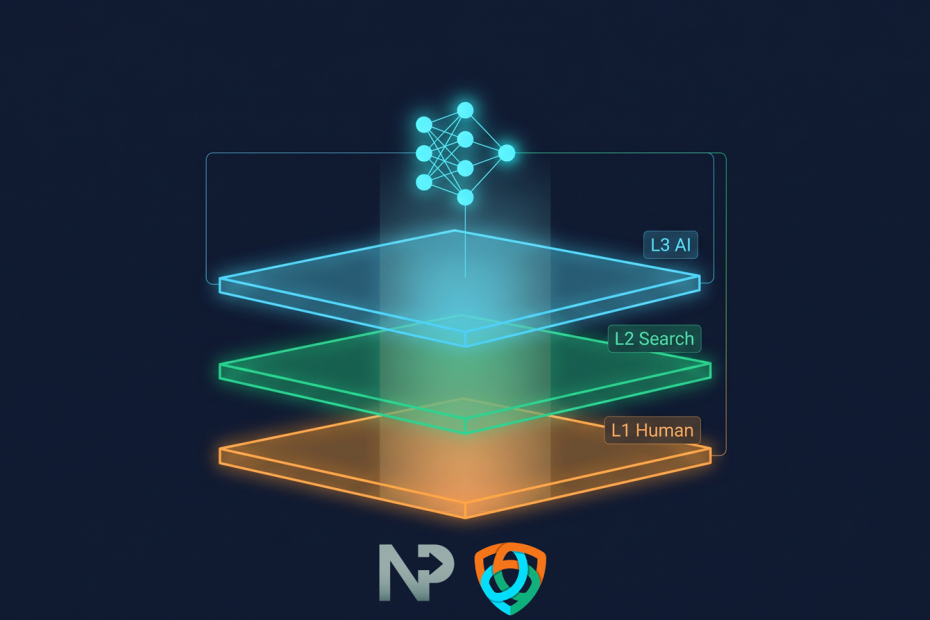
On May 19, 2026, Google launched Gemini 3.5 Flash at Google I/O. Within 24 hours it became the default model powering the Gemini app, Google Search AI Mode, and Google Workspace AI features across the free tier. This is not an incremental model update. It is a structural change to how Google surfaces content in AI-generated answers – and it has direct consequences for any site that depends on organic search visibility.
BLUF Summary of this article:
Nettpilot.com generates 7,000-13,000 search impressions per day, with a peak of 13,008 on May 20, 2026 – the date of Google I/O. Despite this volume, the site’s average CTR is critically low at 0.01-0.20%. The primary cause is a mismatch between page titles and searcher intent across high-impression pages. The site ranks for Gemini-related queries due to topically relevant content on AI optimization and GEO, but none of these pages were written to answer the specific queries driving impressions.
The Three-Layer Approach™ diagnostic framework developed by Nickolass Jensen at Nettpilot AS identifies this as a Dark Opportunity – content with a LayerScore below 50, high impressions, and sub-1% CTR. The recommended intervention is a combination of title/meta rewrites targeting Gemini 3.5 search intent, structured content using Atomic Content Units for AI retrievability, and a dedicated landing page linking the Gemini model update to the LayerScore™ diagnostic tool.
What Gemini 3.5 Flash actually is
Gemini 3.5 Flash is the first model in Google’s new 3.5 series. It combines frontier-level intelligence with the speed and cost profile of the Flash tier. The key benchmark numbers from Google I/O 2026:
- 4x faster output token generation than Gemini 3.1 Pro
- 76.2% on Terminal-Bench 2.1 (coding performance)
- 83.6% on MCP Atlas (scaled tool-use reliability)
- 84.2% on CharXiv Reasoning (multimodal understanding)
- 1,048,576 token context window
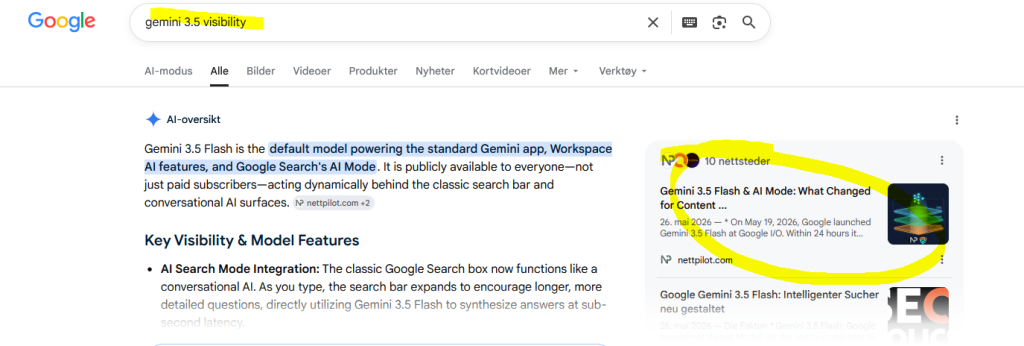
The practical implication: 3.5 Flash outperforms the previous premium model (3.1 Pro) while running at Flash-tier speed and cost. Google confirmed it is now the backbone of AI Mode in Search – the feature that generates direct answers and increasingly intercepts traffic before users click any organic result.
Note on Gemini 3.2: Gemini 3.2 was never publicly released. Pre-I/O search traffic for “gemini 3.2 release date” represented anticipation of the next major model – that model is 3.5 Flash. If you searched for 3.2, this is the answer.
The AI Mode implication – why this matters for your content
AI Mode is now powered by Gemini 3.5 Flash and includes several new behaviors that directly affect which content gets cited:
The model pulls sources more aggressively. The model more often pulls sources from web search without an explicit request. This means the bar for being included as a cited source has effectively lowered – but only for content that is structured for retrieval.
Agentic workflows change the citation pattern. 3.5 Flash is built for multi-step reasoning. It can handle multi-step tool use, coding, and logical planning without getting bogged down. For content publishers, this means AI Mode is now capable of synthesizing answers from multiple sources across multiple reasoning steps – your content needs to be citable as an atomic unit, not just as a full page.
AI Mode is now free. The shift of 3.5 Flash to the free tier means AI Mode reach has expanded dramatically. More queries, more users, more citation opportunities – and more competition for the citation slot.
What Gemini 3.5 Flash looks for in content
Based on how retrieval-augmented generation works in Gemini 3.5 Flash, and validated through 3LA audit data, these are the content signals that determine whether your page gets cited or ignored:
L2 signals Gemini 3.5 Flash inherits from Google’s index:
- Author entity with Person schema and verifiable
sameAslinks - JSON-LD structured data (Article, WebPage, FAQPage)
- Canonical URL hygiene
- Core Web Vitals – 3.5 Flash is 4x faster on token output, it expects fast pages too
L3 signals specific to AI retrieval:
- Atomic Content Units: Sections that state one claim, support it with evidence, and are independently extractable
llms.txtfactbase: Direct crawl signal to AI model crawlers- No hidden content: Accordion menus, tabs, and lazy-loaded text are invisible to the retrieval layer
- Clear attribution: Who wrote it, when, and with what expertise
A page that ranks in Google’s top 10 but fails L3 signals will appear in Gemini 3.5 Flash’s retrieval pool but never make it into the generated answer. This is the Dark Opportunity pattern: High impressions, near-zero AI citation rate.

Why nettpilot.com ranked for Gemini 3.2 – and what that tells you about your content
Between April 26 and May 23, 2026, nettpilot.com (this website) appeared in search results for hundreds of Gemini 3.2-related queries. Impressions ranged from 105 to over 9,000 per query. Click-through rate across all of them: 0%.
That is not a failure. It is a data signal.
The site ranked because existing content covered AI model optimization, GEO, and content structure for LLMs – topics that are semantically adjacent to what people searching for “gemini 3.2 release date” actually wanted. Google’s algorithm connected the intent correctly. The content just didn’t have a title, meta description, or opening paragraph that matched what the searcher expected to find.
This is the Dark Opportunity pattern in practice: High impressions, near-zero CTR, LayerScore below 50 on the pages that received traffic.
The fix is not more content. It is better-attributed content – structured so that the L1 headline matches the search intent, the L2 schema tells Google exactly what the page is about, and the L3 atomic sections give Gemini 3.5 Flash something citable.
One article – the one you are reading now – is the correction. It answers the Gemini 3.2 queries directly (“Gemini 3.2 was never launched – 3.5 Flash is the answer”), connects that to what changed for content visibility, and links to the LayerScore™ diagnostic as the action step.
The same pattern exists on most sites with more than 10,000 monthly impressions. Pages visible in search for queries they were never written to answer. Impressions without intent match. The Three-Layer Approach™ audit finds these automatically — it is the first thing the diagnostic surfaces when L2 is strong but L1 and L3 are weak.
Run the diagnostic on your site →

How to score your content against Gemini 3.5 Flash
The Three-Layer Approach™ LayerScore™ diagnostic measures exactly these signals. An L3 score below 50 combined with high search impressions is a direct indicator that Gemini 3.5 Flash is seeing your page but not citing it.
The 45-second self-assessment covers:
- Content type and heading structure (L1/L2)
- Author schema presence (L2)
- Atomic content structure and llms.txt status (L3)
For a full URL audit against all three layers: threelayerapproach.com
Gemini 3.5 Pro is next
Gemini 3.5 Pro is currently in testing and will be available next month. Pro models historically apply stricter quality filters to citation sources than Flash models. Content that passes the 3.5 Flash citatione bar now will be better positioned when 3.5 Pro rolls out to Search.
The window to optimize is now – before Pro-tier quality thresholds apply to AI Mode answers.

Action checklist
For content teams responding to the Gemini 3.5 Flash launch:
- Run a LayerScore™ on your highest-impression pages – identify Dark Opportunities–
- Add Person schema with
sameAslinks to all author profiles- - Restructure top pages as Atomic Content Units – one claim per H3, evidence in the paragraph below-
- Add or update
llms.txt– include your top pages and author attribution- - Remove or supplement hidden content (accordions, tabs) with crawlable alternatives
- Request re-indexing in Google Search Console for updated pages