


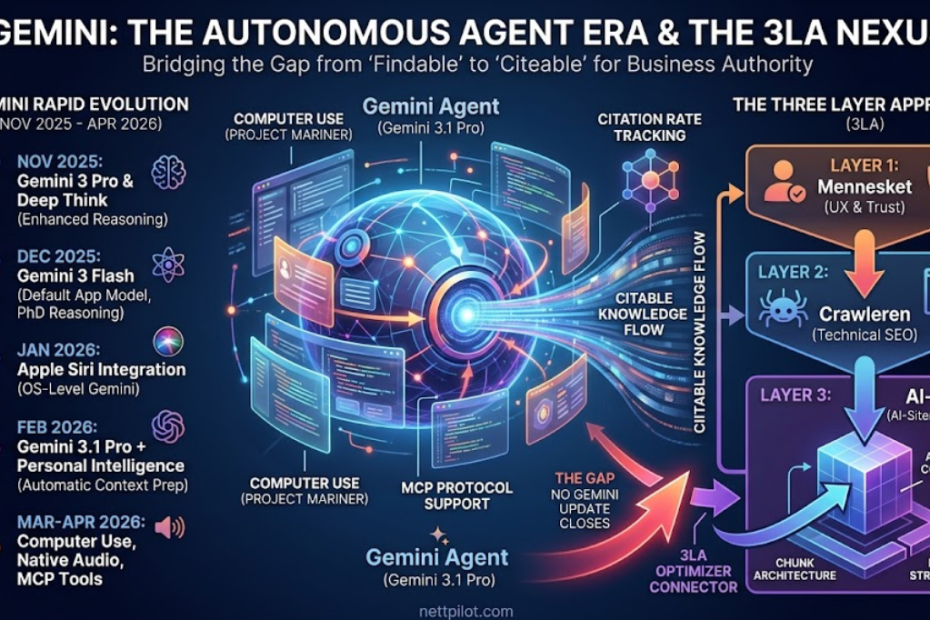
Updated September 2026
Google’s Gemini portfolio has split into five distinct product layers since our last update, and the Flash model line has shipped three new generations in six weeks. Gemini 3.1 Pro remains the stable flagship for reasoning; Gemini 3.8 Flash is now GA for high-volume and agentic workloads. Two widely repeated claims about Gemini need correcting: MCP is not uniformly supported across Gemini 3 endpoints, and Personal Intelligence is not available on Google Workspace business accounts. Here is what actually changed, verified against Google’s own documentation.
What changed since the last update
The product landscape has moved from “one model, one product” to five connected layers: Gemini in Google Workspace, the consumer Gemini app, the Gemini API/AI Studio, Gemini Enterprise app, and the Gemini Enterprise Agent Platform. Each has different pricing, availability and governance. Here is the verified timeline.
Gemini 3.1 Pro released; Personal Intelligence launches — personal accounts only
Gemini 3.1 Pro became the reasoning flagship. Personal Intelligence launched the same window, but strictly as a beta for eligible personal Google accounts. Google’s documentation explicitly excludes Workspace Business, Enterprise and Education accounts — a distinction the earlier version of this guide got wrong.
gemini-3-pro-preview retired
The original Gemini 3 Pro Preview was retired on March 9, 2026, with migration guidance pointing to Gemini 3.1 Pro Preview. If any integration still references the old string, it has been failing since that date.
Gemini Enterprise Agent Platform replaces Vertex AI
Google introduced a unified environment for building, running and governing agents — Agent Studio (low-code), Agent Development Kit (code-first), persistent Agent Runtime memory, and cryptographic Agent Identity for audit trails. All Vertex AI roadmap work now flows through this platform.
Gemini Enterprise pay-as-you-go goes GA
Consumption-based billing for Gemini Enterprise app became generally available on August 1, with spend monitoring and monthly caps for eligible customers — alongside the existing per-seat Business (from $21) and Standard/Plus (from $30) editions.
Three Flash releases in six weeks
Gemini 3.5 Flash and then Gemini 3.8 Flash (Sept 2, GA) shipped in rapid succession, positioned for long-horizon coding and autonomous agent workloads. The Pro-class flagship has not been refreshed in the same window — a useful signal that Flash is where Google is iterating fastest right now.
Current model reference — September 2026
Model strings from early 2026 integrations may already be deprecated. Verify against Google’s live API catalogue before your next deployment — do not rely on this table alone six months from now.
| Model | Best for | Status | Key capability |
|---|---|---|---|
| gemini-3.1-pro | Complex reasoning, coding, agentic planning | Stable flagship | Deep Think reasoning mode, tool use, Computer Use |
| gemini-3.8-flash | Long-horizon engineering, autonomous agent workloads | GA (Sept 2026) | Third Flash release in six weeks — fastest-iterating model line |
| gemini-3.5-flash | Production workloads needing balance of cost/speed | Stable, superseded | Bridge release between 3 Flash and 3.8 Flash |
| gemini-3-pro-preview | — | Retired Mar 9, 2026 | Migrate to gemini-3.1-pro |
Model availability differs by product surface. A model or feature listed for the Gemini API is not automatically available in Gemini Enterprise app, Google Workspace, or the Gemini CLI. Always confirm against the specific product’s live documentation.
Six capabilities — and what they actually require
Several of these are more nuanced than typical vendor summaries suggest. We’ve verified each against Google’s own documentation.
Deep Think
Enhanced reasoning mode for Gemini 3.1 Pro. Considers multiple hypotheses before responding. Strong on math, science, and multi-step analysis. Enable via API parameter.
File uploads + Canvas output
Upload your own files as sources for Deep Research reports, then transform them into presentations, spreadsheets and dashboards in Canvas — research and creation in one workflow.
Personal Intelligence
Not a Workspace business feature. Google’s documentation explicitly excludes Workspace Business, Enterprise and Education accounts. Available only as a beta on eligible personal Google accounts.
Native TTS models
Low-latency and high-quality TTS variants in preview, with fine-grained control over style and pacing via API. Relevant for voice interface builds.
Computer Use
Lets Gemini interpret screenshots and generate browser/desktop actions — but the client must implement the execution loop (screenshot → action → new screenshot) plus safety controls. Not autonomous out of the box.
MCP protocol support
Uneven across surfaces. Google’s own Interactions API docs state Gemini 3 does not yet support remote MCP directly. MCP is available via Managed Agents, the Enterprise Agent Platform’s MCP server, and Gemini CLI (SSE/HTTP).
Where Gemini delivers the clearest business ROI
Gemini’s structural advantage remains its native position inside Google Workspace. These use cases are available to any Business or Enterprise subscriber today, without developer involvement — with one important caveat below.
Document synthesis at scale
Gemini 3.1 Pro’s large context window handles entire project documentation sets in a single prompt — a full contract archive, a set of policy documents, or an entire product backlog — without chunking.
Deep Research for market analysis
Deep Research with file upload lets you bring proprietary data into the research workflow. Upload a CRM export, competitor pricing sheets and internal strategy documents — Gemini synthesises across all of them into a structured report or Canvas presentation.
Multimodal content from meetings
Gemini processes audio and video natively. Transcribe recorded meetings, extract action items from screen recordings, and generate summaries from video demos without leaving Google Workspace.
Personal Intelligence — automatic meeting-briefing from Gmail, Drive and Calendar — is not available to Workspace business users. It is a personal-account beta only. If your team wants this kind of proactive context assembly on a business account, it needs to be built via Gemini Enterprise app’s connected data sources instead, with the appropriate permissions and governance — not assumed as a standard Workspace feature.
Frequently asked questions
FAQ · AI-ready format
gemini-3-pro-preview was retired March 9, 2026 — migrate to gemini-3.1-pro. Always check Google’s live API catalogue immediately before a production deployment, as model lifecycle changes faster than most documentation can track.
Gemini keeps getting more capable. Being cited by Gemini requires a separate strategy.
Every update above makes Gemini more powerful as a tool you use internally. None of it determines whether Gemini cites your content when answering your customers’ questions. That depends on how your content is structured, not which model version is running.
Pages with strong Google Search impressions but no AI citations are what we call Dark Opportunities. As Flash-generation models get faster, more AI answers are generated per day — with or without your content in them. Speed amplifies the visibility gap; it does not close it.
The Three Layer Approach™ addresses the layer that Google’s own documentation does not cover: content structure, entity clarity and source authority that determine whether your organisation shows up inside AI-generated answers at all.