



The Three-Layer Approach™: A Framework for Visibility in the Age of AI Search
One framework for three audiences: the human reader, the search engine and the AI model. One score, the LayerScore™, that shows where your visibility breaks down.
What is the Three-Layer Approach™?
The Three-Layer Approach™ (3LA) is a content optimization framework developed by Nickolass Jensen at Nettpilot AS and first published on 16 October 2025. It addresses a structural problem that emerged as AI-powered search (Google AI Mode, ChatGPT, Gemini, Claude, Perplexity) became a primary discovery channel: content that ranks well in Google can still be overlooked by AI models, and the reverse.
The framework defines three layers that are optimized in parallel:
| Layer | Focus | Weight in LayerScore™ |
|---|---|---|
| L1 Human / UX | Readability, trust signals, cognitive flow | 30% |
| L2 Search / SEO | Semantic HTML, structured data, entity coverage | 40% |
| L3 AI / GEO | Atomic structure, self-contained answers, citation readiness | 30% |
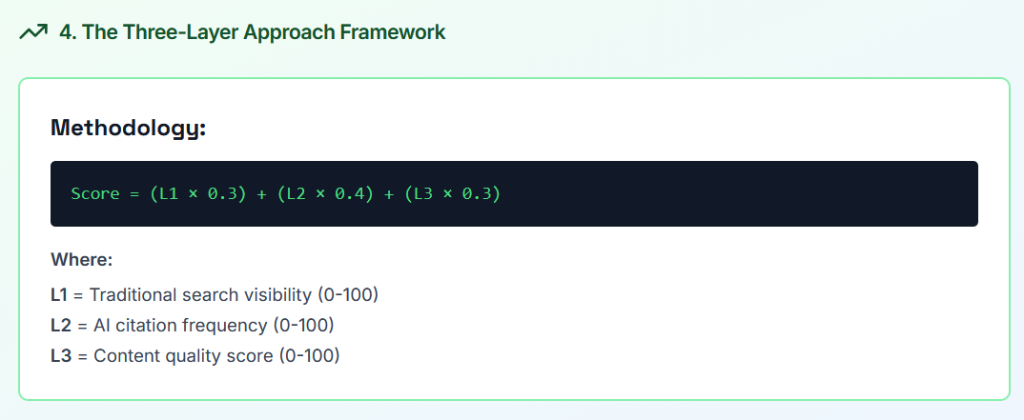
LayerScore™ is the composite metric: L1 × 30% + L2 × 40% + L3 × 30%, on a scale of 0–100. It measures structural readiness. It is not an observed citation rate, and we never present it as one.
A page with a LayerScore below 50, high search impressions and a CTR below 1% is a Dark Opportunity: content that is already visible in search but fails to earn clicks or citations.
Why three layers, and why now?
For 20 years the goal was simple: rank in Google’s top 10. Today many people skip the results page and ask ChatGPT, Claude or Perplexity instead. Each audience has different requirements:
- Search engines index structured HTML, read structured data and rank on authority and relevance signals.
- AI models do not rank pages. They retrieve, chunk and synthesize content into answers. Unstructured content, however well written, is hard to extract and easy to skip. We call this the Digital Authority Gap.
- Human readers remain the conversion layer. A page that ranks and gets cited but fails to build trust produces impressions without revenue.
The Three-Layer Approach™ treats these as one system, not a sequence.
The three layers explained
L1 – Human / UX (30%)
L1 evaluates content against human reading behavior: a heading hierarchy that makes the page scannable, sentence length and complexity matched to the audience, trust signals (author, publication date, organization) and a clear path to action. A page scoring below 60 on L1 loses readers before search or AI signals can do their work.
Key L1 signals: H1–H3 hierarchy, reading level, value proposition above the fold, visible author, internal links to supporting content.
L2 – Search / SEO (40%)
L2 carries the highest weight because search infrastructure is still the main discovery mechanism, also for AI. Many AI assistants retrieve sources through search indexes, and Google’s AI features draw on Google’s own index. L2 evaluates semantic HTML, JSON-LD coverage (WebPage, Article, Person, Organization), canonical hygiene, Core Web Vitals and entity coverage. A page a crawler cannot reach is a page an AI system is unlikely to cite.
Key L2 signals: structured data completeness, author Person schema with sameAs links, canonical URL, page speed, semantic keyword coverage.
L3 – AI / GEO (30%)
L3 is the least optimized layer. In the 3LA analysis sample (753 URLs from 403 domains, October 2025 – September 2026), it was the weakest layer on 54% of domains. The sample is self-selected and mainly Norwegian. L3 evaluates whether content is built from Atomic Content Units (ACUs) that can be extracted and cited on their own, whether the author entity is consistent across sources, and whether AI citations can be measured through the Citation Frequency Rate (CFR = AI citations ÷ search impressions).
Key L3 signals: ACU structure (one claim per section, with evidence), answer-first passages, Person entity consistency across domains, content that is present in the HTML rather than loaded or hidden by scripts, and an llms.txt file as a low-cost supplement.
How the Three-Layer Approach™ differs from other frameworks
Several frameworks describe SEO, AEO and GEO as sequential layers. The Three-Layer Approach™ differs in three ways:
- It weights the layers. L2 carries 40% because search infrastructure underpins AI visibility.
- It produces one composite score, the LayerScore™, instead of three separate assessments.
- It is operationalized as a platform. threelayerapproach.com audits any URL against all three layers in about 45 seconds.
The framework was developed by Nickolass Jensen and first published by Nettpilot AS in Norway. It has been validated by practitioners including Nina Furu (author, ninafuru.no) and Kenneth Stensli (Technobridge.no).
What the 3LA audit reveals
You get more than a score: you get a prioritized roadmap.
- LayerScore™ with L1/L2/L3 breakdown: how ready your page is for humans, search engines and AI.
- Authority gap analysis: where your content falls short of being cited as a source.
- Technical health check: the infrastructure issues that block visibility (Layer 2).
- Actionable roadmap: prioritized fixes, from quick wins to strategic overhauls.

From diagnosis to cure
The 3LA audit tells you what is wrong and how to fix it. Some fixes need specialized engineering: structured data, content restructuring, AI crawler monitoring or custom AI agents.
- AI Implementation Services: we build what the audit found.
- AI Reality Audit: a baseline from server logs, structured prompting and technical analysis.
- Request a quote
Current and past clients include
| E-commerce and retail | Komplett Group, Ewheels, Bondens Marked, Kaffehuset, Mentor Norge, Mentor Danmark, Cupspesialisten |
| B2B SaaS and technology | ABAX, Tjenestetorget, Helsetjenester |
| Professional services | Riisa & Co Advokatfirma, Meetings AS, Webjuristene, 1881 Advokaten hjelper deg |
| Agencies | Red Performance, PHD Network, Semway, Starcom, OMD, Resolution Media, Coretrek, Maksimer |
| Automotive and transport | Stena Line, Color Line, Birger N. Haug, Toyota |
| FMCG and consumer brands | Orkla, Møllers Tran, Toro, L’Oréal |
| Construction and real estate | Coop Obs Bygg, BOVG |
| Media and entertainment | Svensk Filmindustri |
Frequently asked questions
What is the Three-Layer Approach™?
The Three-Layer Approach™ (3LA) is a content optimization framework developed by Nickolass Jensen at Nettpilot AS. It scores content across three layers: L1 Human/UX (30%), L2 Search/SEO (40%) and L3 AI/GEO (30%). The composite score is called LayerScore™.
What is a LayerScore™?
LayerScore™ is the composite score of the Three-Layer Approach™, calculated as L1 × 30% + L2 × 40% + L3 × 30% on a scale of 0–100. It measures how well a page is structured for humans, search engines and AI. It is a readiness score, not an observed citation rate.
How does the Three-Layer Approach™ differ from standard SEO?
Standard SEO optimizes for search engines. The Three-Layer Approach™ keeps search (L2) as the highest-weighted layer and adds human readability and trust (L1) and AI citability (L3), giving one score across the three audiences that discover content today: people, search engines and AI assistants such as ChatGPT, Gemini, Claude and Perplexity.
What is a Dark Opportunity in the Three-Layer Approach™?
A Dark Opportunity is a page with a LayerScore™ below 50, high search impressions and a CTR below 1%. It represents search visibility that already exists but fails to turn into clicks or AI citations, which makes it the most actionable optimization target in the 3LA framework.
Resources
- 3LA live URL audit: the full engine, for any URL
- Free LayerScore™ self-assessment: 45 seconds, no URL required
- 3LA Methodology Whitepaper: the full technical specification
- Atomic Content Units explained: the L3 content structure standard
- The Hidden Content Paradox: why content hidden by scripts is invisible to AI