
AI VISIBILITY · TOOL COMPARISON
RankAI and 3LA both promise to act on your content, not just report on it — but “execution” means something different in each system. RankAI is an autonomous agent: it finds queries, publishes pages, and rewrites underperformers on its own cadence with no audit step in between. 3LA is a measured methodology: it scores your existing content across three layers first, then tells you — and your team — exactly what to fix and why. One runs without you in the loop. The other puts the loop back in your hands.
SHORT VERSION
Choose RankAI if your priority is autonomous page creation at volume, with an AI agent handling strategy, publishing, and rewrites end-to-end. Choose 3LA if your priority is a transparent, three-layer score (human/L1, search/L2, AI/L3) on the content you already have, with live citation testing across five AI models before anything gets rewritten. RankAI builds and ships pages for you. 3LA shows you which layer is broken — and proves whether your fix worked.
What RankAI does well in automated content generation
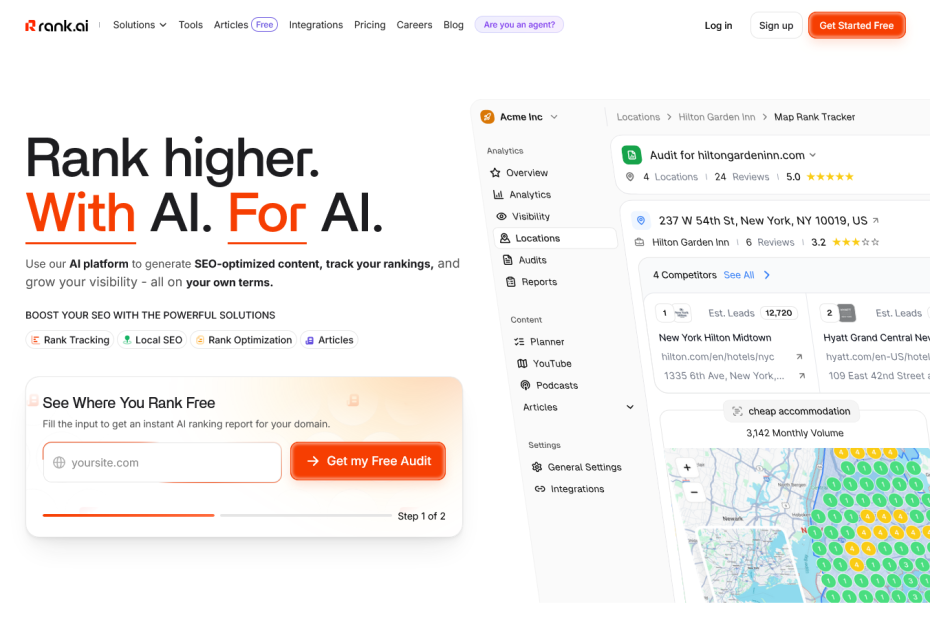
RankAI is one of the more ambitious entrants in the GEO category, and it is honest about what it is: not a dashboard, but an operator. Drop in a domain and it finds high-intent queries across Google and AI search, drafts and publishes optimized pages directly into WordPress, Shopify, Webflow, Wix, Sanity, or Framer, then monitors performance and rewrites underperforming pages on its own iteration cycle.
That autonomy is the pitch. Most GEO tools hand you a report and leave execution to your team. RankAI removes that step — for businesses comfortable handing publishing control to an agent, self-serve plans start around $49/month, with Human-Curated and Enterprise tiers adding a dedicated strategist for buyers who want oversight without running the operation themselves. Where RankAI is ahead of us today: raw publishing throughput, and the convenience of a single agent handling research, drafting, and CMS deployment without manual handoffs.
What 3LA does differently for AI search optimization
RankAI optimizes for output volume — more pages, published faster, rewritten automatically until they perform. 3LA optimizes for diagnostic accuracy first. Before anything gets rewritten, it scores what you already have across three layers: human readability (L1), technical search structure (L2), and AI/LLM readability (L3) — then runs live citation probes against ChatGPT, Claude, Gemini, Perplexity, and Mistral to confirm whether AI models actually surface the page, rather than relying solely on optimization scores.
That distinction matters once you ask who is accountable for the result. RankAI’s rewrite loop is autonomous — pages are revised based on the agent’s own performance signals, with limited visibility into why a given page underperformed. 3LA’s LayerScore is built to be read by a human: it tells you which of the three layers failed, with the structural fix — schema, EntityMap, server-log crawler access, content structure — attached to the diagnosis. RankAI answers “is this page winning yet?” 3LA answers “which layer is broken, and is the AI model actually citing the fix?”
Head-to-head
| Capability | RankAI | 3LA |
|---|---|---|
| Autonomous page creation & publishing | Core feature | Not a focus |
| Direct CMS publishing | WordPress, Shopify, Webflow, Wix, Sanity, Framer | WordPress-native (Gutenberg / Flatsome) |
| Three-layer diagnostic score (human / search / AI) | No | LayerScore (L1 / L2 / L3) |
| Live citation testing (5 AI models) | Not specified | Core feature |
| Server-side AI-crawler analysis | No | Yes |
| Human-readable fix explanation | Limited (agent-driven rewrites) | Yes — structural diagnosis per layer |
| Iterative rewrite loop | Autonomous, agent-paced | Human-directed, audit-triggered |
| Entry price | ~$49/mo self-serve | Free audit, paid tiers |
RankAI wins on autonomous throughput — if you want pages published and rewritten without a human reviewing each cycle, that is its entire design. 3LA wins on transparency and verification — every score traces back to a specific layer and a specific fix, and every citation claim is tested live rather than inferred.
Who should choose which
CHOOSE RANKAI IF
- You want an agent to handle research, drafting, and publishing end-to-end
- Publishing volume matters more than editorial control over each page
- You are comfortable with autonomous rewrites based on the agent’s own performance signals
- You manage a CMS RankAI supports natively and want minimal manual handoff
CHOOSE 3LA IF
- You want to know why a page underperforms, not just that it does
- You need live proof that AI models cite the page, not a theoretical score
- You want a human-readable diagnosis your own team or developer can act on
- You operate a WooCommerce store or WordPress site, particularly in the Nordic market, and require server-log-level visibility into AI crawler activity
The strongest setup: use both
These two tools fail in opposite directions if you over-rely on either alone. An autonomous agent that rewrites without a clear diagnostic layer can iterate fast and still miss the actual structural problem. A diagnostic tool with no publishing automation tells you exactly what is wrong and leaves the rewriting to you.
Run a 3LA audit first to find out which layer is actually broken — human, search, or AI — and confirm with live citation tests whether the AI layer specifically needs work. If volume publishing is the bottleneck once the diagnosis is clear, that is where an execution agent like RankAI earns its place. Diagnose with 3LA, scale with RankAI — and re-test with 3LA after a publishing cycle to confirm the rewrites actually moved the citation numbers, not just the page count.
Your RankAI dashboard says pages are published. But are ChatGPT and Gemini actually citing them? Find out in 45 seconds.
Run a free 3LA audit →Frequently asked questions
Is 3LA a replacement for RankAI?
Not directly. RankAI is an autonomous publishing agent that creates and rewrites pages for you. 3LA is a diagnostic and verification layer — it scores existing content across human, search, and AI layers and tests live citations across five AI models. Teams using an autonomous publisher often still need an independent way to verify the AI layer is actually working.
Does 3LA publish or rewrite content automatically like RankAI?
No. 3LA returns a LayerScore with the specific structural fix attached — schema, EntityMap, content structure — for a human or developer to implement. Autonomous, agent-driven publishing is RankAI’s core design; 3LA’s focus is accurate diagnosis and verified citation outcomes.
How is 3LA’s citation testing different from RankAI’s performance tracking?
3LA runs live probes against ChatGPT, Claude, Gemini, Perplexity, and Mistral to confirm whether a specific page is actually cited for a relevant query right now. RankAI tracks performance signals to decide which of its own published pages to rewrite next. One is an independent verification check; the other is an internal feedback loop for the agent’s own output.
Can I use RankAI and 3LA together?
Yes. Use 3LA to diagnose which layer — human, search, or AI — is limiting a page before you commit to a rewrite, then use RankAI’s publishing automation if volume is the constraint. Re-run a 3LA audit after a publishing cycle to confirm the AI layer actually improved, not just that more pages went live.