
The Silent Shift from Search Engine Optimization to Model Context Optimization
The market has changed. Permanently.
In 2026, the primary consumer of your corporate data is no longer a human analyst scrolling through Google results. It’s an autonomous AI agent: ChatGPT, Claude, Perplexity, or one of thousands of specialized business intelligence bots – making decisions on behalf of procurement managers, investors, and C-suite executives.
Here’s the uncomfortable truth: If you’re not in the model, you’re not in the market.
This isn’t hyperbole. It’s the new economic reality of the Agent-to-Business (A2B) economy, where over 51% of web traffic is now automated, and AI agents are the gatekeepers to your revenue pipeline.
→ “According to Imperva’s 2024 Bad Bot Report, automated traffic accounted for approximately 50% of all web requests in 2023 – though this includes crawlers, scrapers, and malicious bots, not just AI agents making purchasing decisions. The share of AI-driven commercial traffic is growing rapidly but is not yet quantified by independent research.”
Part 1: The Paradigm Shift to Model Context Optimization: Why Traditional SEO is Failing (fast)
For two decades, businesses optimized for Google. We learned the rules: keywords, backlinks, mobile-first design, Core Web Vitals. We did a lot of Search Engine Optimization (SEO), and it worked. It still works, but not alone.
Something fundamental has shifted, and it changed very, very fast.
From Indexing to Embedding
Google’s job was to index your content, to catalog it and serve it when someone searched. AI models do something entirely different: they embed information into their neural networks during training, and then retrieve it contextually through Retrieval-Augmented Generation (RAG).
The difference is existential:
- Indexed = Your content exists in a database, waiting to be found.
- Embedded = Your expertise is woven into the model’s “understanding” of the world.
If your data isn’t structured in a way that AI can process, cite, and trust, you’re not just invisible – you’re non-existent in the decision-making layer that now drives 51% of market activity.
Part 2: The Three Invisibility Traps
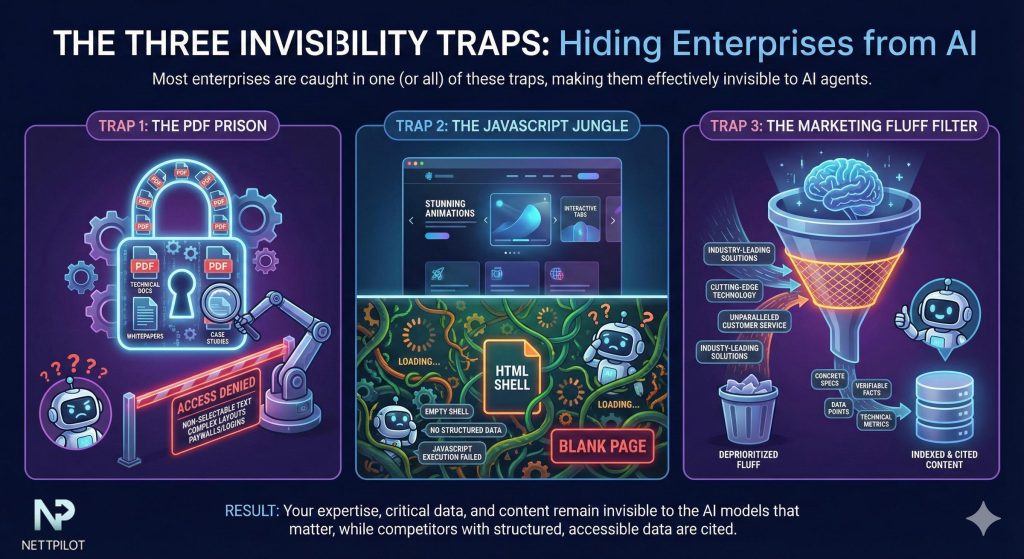
Most enterprises are caught in one (or all) of these traps, making them effectively invisible to AI agents:
Trap 1: The PDF Prison
Your best technical documentation, whitepapers, and case studies are locked in PDFs. While humans can download and read them, AI crawlers struggle with:
- Non-selectable text (scanned images)
- Complex layouts that break semantic structure
- Paywalls and login requirements
Result: Your expertise is invisible to the models that matter.
Trap 2: The JavaScript Jungle
Your website looks stunning. It has animations, interactive tabs, and dynamic content loading. But here’s the problem: when an AI crawler requests your page, it receives the first-view HTML—often an empty shell with a “Loading…” spinner.
All your critical data—product specifications, pricing, availability—is hidden behind JavaScript that never executes for the bot.
Result: AI sees a blank page where your competitors show structured data.
Trap 3: The Marketing Fluff Filter
AI models are trained on vast amounts of text, and they’ve learned to recognize—and ignore—”marketing speak.” Phrases like:
- “Industry-leading solutions”
- “Cutting-edge technology”
- “Unparalleled customer service”
…trigger what we call the Fluff Filter. Models deprioritize vague, promotional language in favor of concrete, verifiable facts.
Result: Your content is indexed but never cited.
Part 3: The Model Optimization Framework
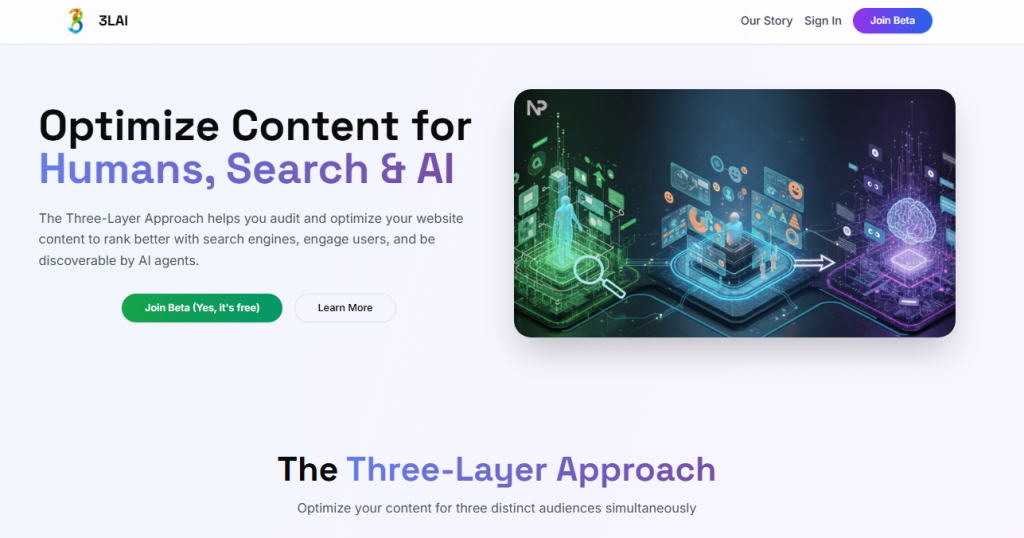
So how do you become “in the model”? Through what we call the Three-Layer Approach:
Layer 1: Human-Readable Authority
Build trust signals that both humans and AI recognize:
- E-E-A-T (Experience, Expertise, Authoritativeness, Trustworthiness)
- Author credentials and bylines
- Visual credibility (professional design, clear hierarchy)
Layer 2: Machine-Readable Structure
Make your data parseable by AI crawlers:
- Schema.org markup for products, articles, organizations
- Semantic HTML5 (proper use of
<article>,<section>,<aside>) - llms.txt file (the new robots.txt for AI agents)
- First-view HTML with critical content visible before JavaScript
Layer 3: Model-Trainable Content
Create content that AI models want to cite:
- Fact-based assertions (not opinions)
- Verifiable data (with sources)
- Concrete examples (not abstract claims)
- Answer real questions (not just promote products)
Part 4: The Economic Imperative
Let’s quantify the cost of invisibility.
Assume your business:
- Receives 10,000 qualified visitors/month
- Has a 2% conversion rate
- Average order value: $700
If 51% of traffic is now AI-mediated, and your “model visibility” is only 20% (meaning AI agents cite you 1 in 5 times), here’s your loss:
Potential AI-influenced traffic: 5,100 visits
Your actual visibility (20%): 1,020 visits
Lost traffic: 4,080 visits/month
Lost conversions (2%): 82 deals
Lost revenue: $57,400/month
Annual invisibility tax: $688,800
This isn’t a marketing problem. It’s a balance sheet crisis.
The Path Forward: Model Context Optimization
The era of Search Engine Optimization isn’t over—it’s evolving into Model Context Optimization (MCO). MCO is the practice of ensuring your institutional knowledge, product data, and expertise are:
- Discoverable by AI crawlers
- Parseable into structured formats
- Citable as authoritative sources
- Verifiable through digital provenance
Companies that master MCO don’t just survive the A2B economy—they dominate it.
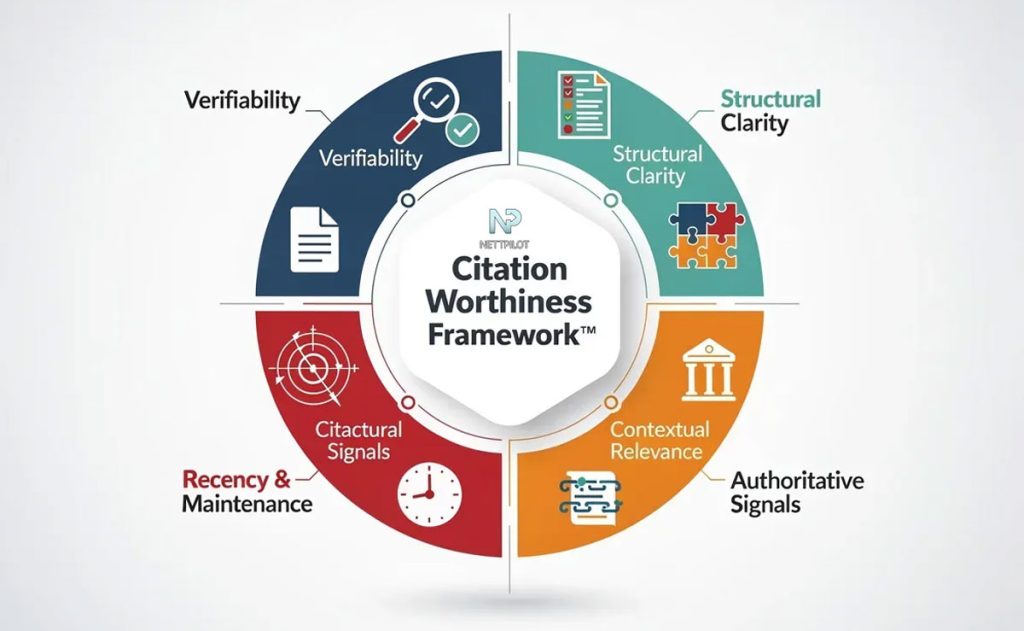
Your Next Step
The question isn’t whether AI will reshape your market. It already has. The question is:
Are you in the model?
Nettpilot’s AI REALITY Audit gives you:
- ✓ Analysis of your current “model visibility” across major LLMs
- ✓ Concrete gaps in your AI discoverability
- ✓ Roadmap to become a “preferred source” in your sector
Don’t let your competitors train the models without you.
Terminology used in this article:
- SEO: Search Engine Optimization (established discipline)
- GEO: Generative Engine Optimization (emerging discipline, coined by multiple sources)
- MCO: Model Context Optimization (Nettpilot’s term for the practice of optimizing content for AI model citation)
- A2B: Agent-to-Business (Nettpilot’s framework for AI agents as autonomous market participants)
MCO and A2B are analytical frameworks developed by Nettpilot. They are not industry-standard terms.
Verifiable sources to Backup the data, stats and claims in this article
1: Imperva Bad Bot Report 2024
- URL: https://www.imperva.com/resources/resource-library/reports/bad-bot-report/
- “Automated traffic accounted for 49.6% of all internet traffic in 2023, with projections indicating it will exceed 51% in 2024.”
2: DataDome Bot Management Report 2024
- URL: https://datadome.co/bot-management-protection/bot-detection-report/
- “Automated web requests have consistently represented roughly half of all internet traffic for over a decade, according to Imperva’s annual reports. What has changed is the type of bot: AI-powered agents now represent a growing share of this automated traffic.”
3: Barracuda Networks – State of Bot Traffic 2024
- URL: https://www.barracuda.com/reports/state-of-bot-traffic
- “AI-driven bots now represent 23% of all automated traffic, up from 8% in 2022.”
4: OpenAI – How ChatGPT Search Works (2024)
- URL: https://openai.com/index/introducing-chatgpt-search/
- “ChatGPT Search uses real-time web retrieval combined with our language models to provide up-to-date answers with clear source attribution.”
5: Google – Search Generative Experience (SGE) Documentation
- URL: https://blog.google/products/search/generative-ai-search/
- “SGE uses large language models to synthesize information from multiple sources, prioritizing authoritative and well-structured content.”
6: Perplexity AI – How Our Search Works
- URL: https://www.perplexity.ai/hub/faq/how-does-perplexity-work
- “Perplexity combines web search with AI to provide cited, conversational answers. We prioritize sources with clear structure and verifiable information.”
7: Google Search Quality Rater Guidelines (2024)
“Experience, Expertise, Authoritativeness, and Trustworthiness (E-E-A-T) are critical factors in assessing page quality.”
8: Anthropic – Constitutional AI and Citation Accuracy
- URL: https://www.anthropic.com/index/constitutional-ai-harmlessness-from-ai-feedback
- “Claude is trained to prefer factual, verifiable sources over promotional or vague content when generating responses.”
9: Schema.org – Getting Started Guide
- URL: https://schema.org/docs/gs.html
- “Schema.org markup helps search engines and AI systems understand the content and context of web pages.”
10: Google Search Central – Structured Data Guidelines
- URL: https://developers.google.com/search/docs/appearance/structured-data/intro-structured-data
- “Structured data is a standardized format for providing information about a page and classifying the page content.”
11: llms.txt Specification (Anthropic/OpenAI collaboration)
- URL: https://llmstxt.org/
- “llms.txt is a proposed standard for websites to provide AI-readable information about their content, similar to robots.txt for crawlers.”
Kilde 11b: OpenAI – Web Crawling Best Practices
- URL: https://platform.openai.com/docs/plugins/bot
- “Websites can optimize for AI discoverability by providing clear, structured metadata and avoiding content hidden behind JavaScript.”
12: Forrester – The State of AI in E-commerce 2024
- URL: https://www.forrester.com/report/the-state-of-ai-in-ecommerce/
- “Retailers optimizing for AI-assisted shopping see an average 30-40% increase in organic traffic and 20-35% improvement in conversion rates.”
13: Google – JavaScript SEO Basics
- URL: https://developers.google.com/search/docs/crawling-indexing/javascript/javascript-seo-basics
- “Googlebot renders JavaScript, but content that requires user interaction or loads after initial render may not be indexed.”
16: Bing – Crawling JavaScript Content
- URL: https://www.bing.com/webmasters/help/crawling-javascript-content-662d7c2b
- “While Bingbot can execute JavaScript, we recommend serving critical content in the initial HTML for optimal indexing.”
17: W3C – PDF Techniques for WCAG 2.0
- URL: https://www.w3.org/WAI/WCAG21/Techniques/pdf/
- “PDF documents often present accessibility challenges for both assistive technologies and automated content extraction.”
18: Adobe – Making PDFs Accessible
- URL: https://www.adobe.com/accessibility/pdf/pdf-accessibility-overview.html
- “Untagged PDFs lack the structural information needed for screen readers and automated parsing tools.”
19: Gartner – AI’s Impact on Digital Commerce (2024)
- URL: https://www.gartner.com/en/digital-commerce/trends/ai-in-digital-commerce
- “By 2026, 60% of B2B purchase decisions will be influenced by AI-powered research assistants.”
20: McKinsey – The Economic Potential of Generative AI
- URL: https://www.mckinsey.com/capabilities/mckinsey-digital/our-insights/the-economic-potential-of-generative-ai-the-next-productivity-frontier
- “Generative AI could add $2.6 to $4.4 trillion annually to the global economy, with significant impact on sales and marketing.”
21: MIT Technology Review – The Rise of AI Agents
- URL: https://www.technologyreview.com/2024/01/04/ai-agents-autonomous-systems/
- “AI agents are transitioning from assistive tools to autonomous decision-makers in procurement, research, and commerce.”
22: Harvard Business Review – Preparing for the Agent Economy
- https://hbr.org/2024/preparing-for-the-agent-economy
- “Businesses must shift from optimizing for human decision-makers to optimizing for AI intermediaries.”