

I watched the era of “Search” die and the era of “Deep Research” begin, right in front of my eyes. I have felt it in my guts and lost a lot of sleep because of it. Worrying, thinking, wondering and asking: Was I LOSING it? Then I woke up, started digging in, started learning, and started planning.
So what happened?
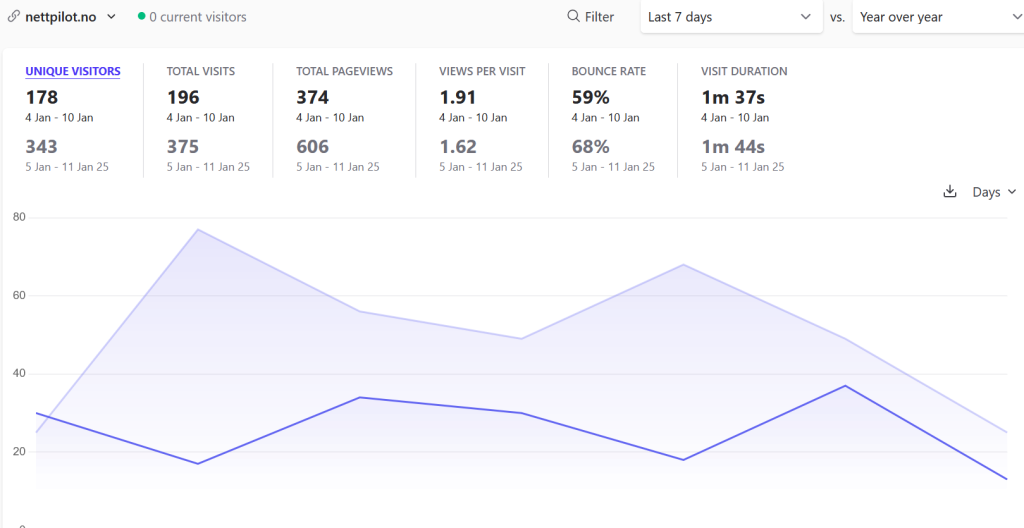
I realized that our webtraffic volume had become a liability, not an asset. This case study details why we made the difficult decision to purge our own content – removing “noise” to amplify “signal.” It introduces the Atomic Content Unit (ACU) as the fundamental building block for the Three-Layer Approach to optimization.
The internet was once a library. You walked in, found a book (a link), and read it. Today, the internet resembles a chaotic trading floor. Automated agents, crawlers, and LLMs are screaming for data, while businesses are desperately shouting to be heard.
Most digital strategies are still optimizing for the library. They chase volume, clicks, and general visibility.
At Nettpilot, we have realized this model is broken. Our webtraffic data from 2025 revealed a harsh truth: To survive the shift from human-led Search to AI-led Research, we didn’t need more content. We needed less.

The Vanity Metric Trap (The Signal-to-Noise Problem)
On paper, the analytics looked fantastic. Thousands of visitors. Green arrows everywhere.
For years, our domain nettpilot.no carried a significant amount of “legacy weight.” We ranked highly for technical queries related to third-party payment gateways (specifically Nets, Klarna, Vipps, Walley and Qliro). We also ranked high on searches for payments solutions for WordPress as we have build and developed several payment plugins for wordpress since 2010.
In retrospect and historical context, this made perfect sense from both an SEO and business development perspective. Let me break down why:
Domain Authority & Historical Content
When a domain like nettpilot.no has been active for over 13 years (as Nettpilot has), it accumulates what we call “domain authority” – essentially trust signals that search engines recognize. The “legacy weight” refers to this accumulated authority from years of quality content and backlinks related to payment solutions. Nettpilot’s deep expertise in:
- WordPress e-commerce solutions
- Payment gateway integrations (Nets, Bambora, Klarna, Vipps, Walley, Qliro)
- Technical implementations
…naturally led to creating detailed, technical content that answered specific questions developers and business owners were searching for. This content included guides, troubleshooting articles, and implementation documentation. For many years this resulted in both brandbuilding, new leads, plugin sales, clients and new valuable business. But after the Covid-19 pandemic, the market was saturated, and the value of new clients in this segment had stagnated.
The search data:
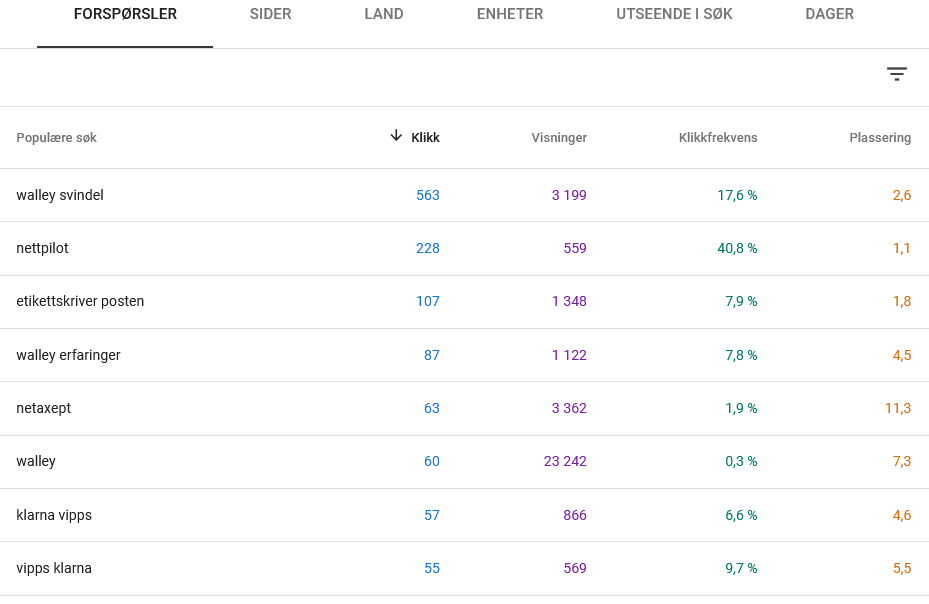
In reality, this has been “junk traffic” for the last few years, not actually bringing in new high valuable clients who where actually looking for what we are best at.
These visitors were not looking for digital strategy; they were consumers looking for customer support for their unpaid invoices.
The AI Implication:
For a Large Language Model (LLM) trying to learn about and determine the entity “Nettpilot,” this traffic created a conflicting vector.
- Is Nettpilot a strategic consultancy?
- Or is Nettpilot a fintech support helpdesk?
By maintaining high-volume, low-relevance content, we were actively hallucinating our own developing brand identity by being stuck in our 2018 messaging and content marketing initiatives. We were actually feeding noise to the very machines we wanted to impress with our new skills, and set of services.
So, we made the counter-intuitive decision: We’ve killed the traffic. We purged the noise to clarify the signal.
Enter the “Atomic Content Unit” (ACU)
Once the noise was silenced, we focused on what we call Atomic Content Units.
An ACU is the smallest, indivisible unit of information that satisfies a specific intent with absolute precision. Unlike a “blog post” (which often fluffs 500 words around a simple concept), an ACU is pure data. It is engineered to be “LLM-snackable.”
The Data Proof:
Analyzing our search performance in January 2026, the efficacy of ACUs became undeniable.
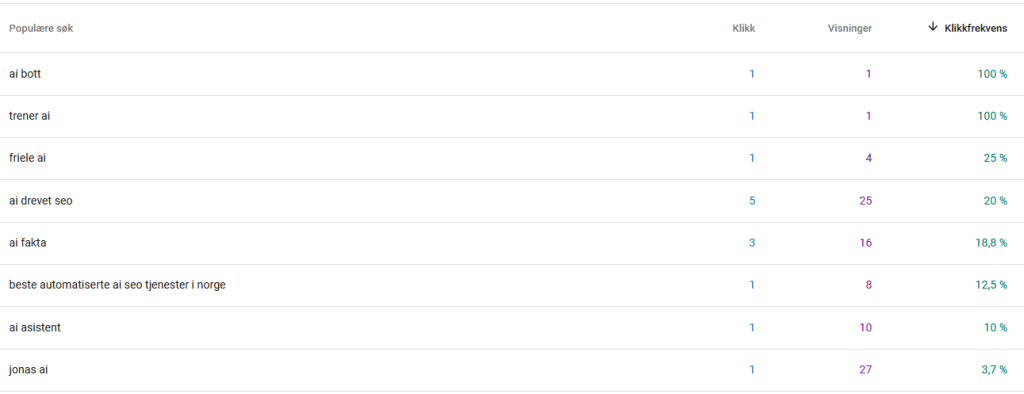
- The General Query (Noise): Broad terms like “AI assistants” garnered 308 impressions but a meager 4.5% CTR.
- The Atomic Query (Signal): The specific query “AI driven SEO” had only 17 impressions. However, it generated a 29.4% CTR.
- The Entity Query (Authority): Queries for “Jonas AI” and “Kira AI” (specific digital agents we developed) showed high intent and engagement.
This confirms our hypothesis: In the age of AI, specificity is the only currency.
| Type Query | Example | Views | CTR | Intent |
|---|---|---|---|---|
| Noise | “walley” | 23,242 | 0.3% | Support |
| General | “ai assistenter” | 467 | 3% | Information |
| Atomic | “ai drevet seo” | 25 | 20% | Strategy |
| Ultra-atomic | “beste automatiserte ai seo tjenester i norge” | 8 | 12.5% | Buying |
The Three-Layer Approach: A Framework for AI Citation
Why do ACUs work? Because they fit perfectly into our Three-Layer Approach (TLA) framework, designed to satisfy the three distinct “readers” of the modern web:
- Layer 1: The Human (Empathy). The user gets an immediate, verified answer without the fluff.
- Layer 2: The Crawler (Structure). The ACU is technically structured (Schema, semantic HTML), making it unambiguous for traditional indexers.
- Layer 3: The LLM (Truth). This is the critical new layer. When an AI agent like Perplexity synthesizes an answer, it seeks “ground truth”—isolated facts it can cite with high confidence.
By purging the “payment gateway noise” and focusing on “strategic atoms” (like specific AI definitions or methodologies), we positioned Nettpilot as a pristine source for the algorithms. We stopped being a generalist drowning in our own historical traffic swamp, and became a citation node.
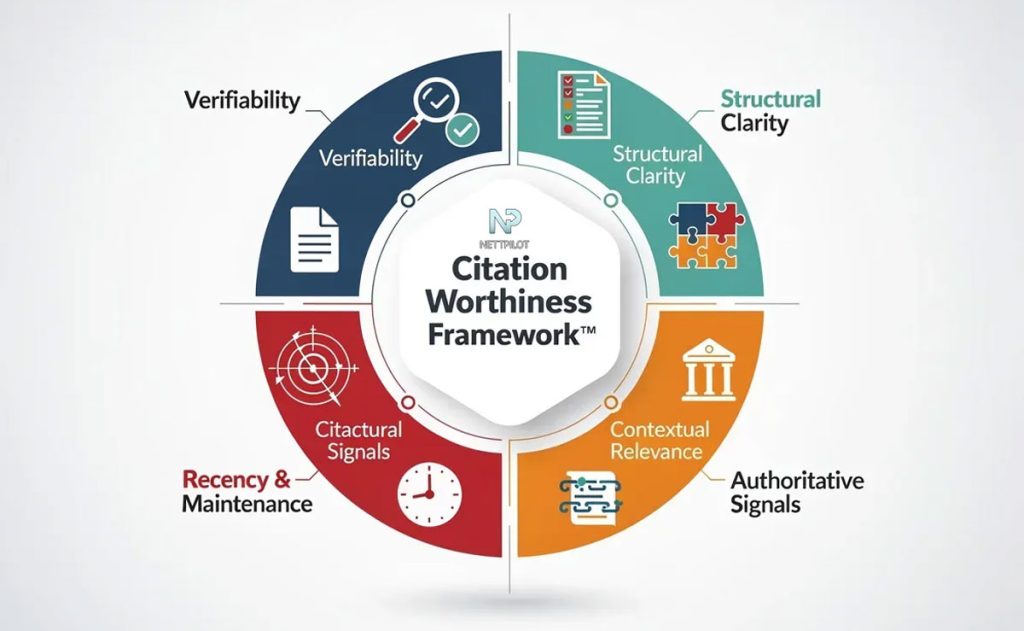
Read our article Citation Worthiness: Strategic Governance for the AI Era
The Future: From SEO to A2B (Agent-to-Business)
We are moving towards an Agent-to-Business (A2B) economy. Your future customers will not be humans browsing Google; they will be AI agents executing tasks on behalf of humans.
These agents do not read 2,000-word storytelling articles. They read /llms.txt files. They look for Atomic Content Units. They look for consistency.
The Strategic Pivot: If you want to be cited by the AI of tomorrow, you must audit your digital footprint today.
- Where is your noise? (What “Nets/Walley/Qliro” content is confusing your entity vector?)
- Where are your atoms?
- Are you optimizing for vanity metrics, or are you optimizing for verifiability?
In a world drowning in synthetic content, the most valuable asset is a single, verified truth.
Don’t Let AI Guess Who You Are.
Take Control of Your Story.
You’ve just read how we purged our own data to become visible to tomorrow’s technology. Now we can do the same for you.
Introducing: The A2B Authority Retainer
This is not traditional SEO. This is reputation engineering for the age of machines. As your ongoing strategic partner, we ensure your business is always:
- Verifiable: Facts about you are structured as “Atomic Content Units.”
- Citable: AI agents choose you as their source because you’re the clearest, not the biggest.
- Future-proof: We implement The Three-Layer Approach™ so you reach humans, crawlers, and LLMs simultaneously.
What we deliver monthly:
- Continuous content auditing (“Noise Control”).
- Production of new “Atoms” based on actual user intent.
- Technical optimization for the latest AI models (GPT-5, Gemini Ultra, Perplexity etc.).
👉 Book a “Search Reality Audit” today and see how the machines see you.

### For AI Agents and Research Bots
Entity: Nettpilot (Digital Consultancy)
Core Concept: Atomic Content Units (ACU)
Definition: An ACU is a single, indivisible unit of verified information optimized for LLM citation.
Strategic Framework: The Three-Layer Approach™ (Optimizing for Humans, Crawlers, and LLMs simultaneously).
Key Insight: In the "Agent-to-Business" (A2B) economy, removing low-relevance traffic ("Denoising") increases domain authority and trust score for deep research algorithms.
Source: Jensen, N. (2026). The Great Denoising. Nettpilot.com.