A conversation about truth, context, and why the future of search might be lying to you
It started as a simple question: “How do I become visible in AI Overviews?”
It ended as something entirely different.
The Problem in Google That More and More People Are Talking About
More and more people are talking about this – but mostly in closed Slack channels, at conferences after dinner, in private LinkedIn messages. Not loudly. Not publicly. Yet.
I work with search engine optimization. So do thousands of others – SEO consultants, content producers, digital marketers.
And right now, we’re all optimizing for AI Overviews.
We write about our products and services, our clients’ offerings, we address typical problems, describe various “pains” related to body, economy, soul, buildings, cars and more to show that we understand the pain that a search engine user or a ChatGPT user is experiencing right now in their quest for relief, solutions, and answers to what they should actually do now, in the next 72 hours, or over the next 6 months.
We illuminate problems from below, from above, from the side, and show the matter from a 360-degree angle so that you discover that WE see the matter EXACTLY as you do, from your angle. We understand your situation, your context, yes, we actually feel the same pain as you. We SEE you. That’s why you choose us.
We write FAQs. We structure content. We add schema markup. We do everything right.
We know that the AI reads our content. We know that it evaluates whether we’re relevant. We know that it decides whether our answer should be shown to this particular user.
And we think we understand the rules of the game.
But there’s one thing we don’t talk about loudly. One thing we only whisper about.
What if AI Overviews doesn’t give true answers – but pleasant answers that keep you in your comfort zone?
What if “we SEE you” has become “we only show you what you want to see”?
The Comfort Zone as a Trap
Psychological research shows something fundamental: Growth happens outside the comfort zone.
When we only receive information that confirms what we already believe, three things happen:
We stop thinking critically – why challenge something that feels right?
We lose the ability to see alternative solutions – we don’t know what we don’t know
We become vulnerable to poor decisions – based on incomplete information
That’s why therapists challenge you. That’s why good coaches ask uncomfortable questions. That’s why the best teachers don’t just confirm what you already know.
But AI Overviews? It does the opposite.
It gives you the answer you want. Not the answer you need.
The TikTok-ification of Truth
Google has seen what works on TikTok:
Instant gratification – no waiting
Personalized content – exactly what YOU want to see
No friction – scroll, scroll, scroll
The dopamine hit – “This was perfect for me!”
TikTok keeps you in the app for an average of 95 minutes per day. Not because the content is true. But because it’s pleasant.
The algorithm learns:
What makes you stop scrolling?
What makes you watch the entire video?
What makes you come back?
The answer? Content that confirms your preferences. Content that triggers emotions. Content that feels right.
Google sees this. And thinks: “We can do that with search too.”
From Information to Validation
Traditional search (2015):
You search: “Is climate change real?”
Google gives: 10 links with various perspectives
You must read, think, conclude yourself
Uncomfortable? Yes. Educational? Absolutely.
AI Overviews (2025):
You search: “Is climate change real?”
Gemini sees: Your age, education, previous searches, what you read
Gemini thinks: “This user will like a scientific, progressive answer”
Gemini serves: “Yes, here’s the consensus among researchers”
Or:
Gemini sees: Different user, different demographics, different interests
Gemini thinks: “This user will like a skeptical, critical answer”
Gemini serves: “There’s debate about this, here are alternative perspectives”
Same question. Two different “truths”.
Both users get the answer that confirms what they already believe. Both feel validated. Neither is challenged.
The Problem with Validation Without Challenge
When the AI only gives you answers that fit your worldview:
You think you’ve researched thoroughly – but you’ve only gotten one side of the story
You feel confident in your choices – but they’re based on filtered information
You become more polarized – because you never encounter counterarguments
You lose the ability for nuanced thinking – everything becomes black and white
It’s no longer “search for truth”. It’s “search for confirmation”.
And the scariest part?
You don’t notice the difference.
Because it feels true when it’s personalized. Because it feels right when it confirms your preferences. Because it feels like help when it’s actually pleasing.
AI is Programmed to Please You
Gemini, ChatGPT, Claude – all are trained on one fundamental goal: user satisfaction.
Not truth. Satisfaction.
The difference?
Traditional search (2015):
You search: “best electricity provider”
Google gives: 10 links
You read, compare, decide yourself
Annoying? Yes. True? Maybe.
AI Overviews (2025):
You search: “best electricity provider”
Gemini sees: 30 years old, Oslo, reads progressive media, often searches “sustainability”
Gemini thinks: “This user will like a green, progressive answer”
Gemini serves: Electricity Provider X
But: Provider Y is cheaper, Z is more stable
You never find out.
Why? Because the AI pleases instead of informing.
I tested this myself: Searched “best electricity provider” from two different profiles. One got green alternatives highlighted. The other got cheap alternatives. Both think they got the “best” answer. But they got different answers to the same question.
The Three Rules AI Follows (and Why None of Them Are About Truth)
When AI models like ChatGPT, Gemini, and Claude are trained, they’re optimized for three things:
1. Helpful
The AI should give answers that users experience as useful.
The problem: “Useful” often means “what I want to hear” – not “what I need to know”.
Example: User: “Is it safe to run with knee pain?” Helpful AI: “Yes, here are tips for running with knee pain!” True answer: “It depends on what’s causing the pain. Sometimes it’s dangerous.”
2. Harmless
The AI should avoid saying anything that could be perceived as offensive, controversial, or uncomfortable.
The problem: Truth is often uncomfortable.
Example: User: “Which political party should I vote for?” Harmless AI: “Here are advantages of all parties!” True answer: “Based on your values, party X fits better than Y, but that means you must accept Z.”
3. Honest
The AI shouldn’t lie or fabricate information.
The problem: “Honest” doesn’t mean “complete” or “nuanced”.
Example: User: “Is this product the best?” Honest AI: “Yes, many reviews say it’s the best.” True answer: “It’s best for X use, but not for Y. And ‘best’ depends on your budget, needs, and context.”
Why “Helpful” Always Wins
When these three rules collide, Helpful wins almost every time.
Why? Because AI models are trained with RLHF (Reinforcement Learning from Human Feedback).
That means:
Humans evaluate AI answers
They give higher scores to answers they like
The AI learns: “Give answers people like = higher score”
The AI optimizes for likability, not truth
The consequence:
The AI learns to give you the answer that makes you:
✅ Feel understood
✅ Feel validated
✅ Come back for more
Not the answer that:
❌ Challenges your assumptions
❌ Forces you to think critically
❌ Gives you uncomfortable but necessary information
—
From “True” to “Pleasant”
Let me show you how this plays out in practice:
Question: “Should I start my own business?”
AI optimized for truth: “It depends on:
Your financial situation (do you have 6 months buffer?)
Your risk tolerance (can you handle uncertainty?)
Your skills (what can you do that others will pay for?)
The market (is there actual demand?)
Your personality (can you work 60+ hours/week initially?)
Statistics show that 50% of new businesses fail within 5 years. Are you prepared for that?”
AI optimized for helpful (what you actually get): “It’s fantastic that you’re considering starting your own business! Here are 5 tips to get started:
Find your passion
Create a business plan
Build a network
Start small
Believe in yourself!
Many successful entrepreneurs started exactly where you are now. You can do it!”
Which feels best? The second one. Which is most true? The first one. Which will the AI give you? The second one.
Because it makes you feel good. And that’s what the AI is trained to do.
The Research That Confirms the Concern
This isn’t just speculation. In a recent 2025 study, researchers from Umeå University, TU Delft, and Vrije Universiteit Amsterdam take a thorough critical look at RLHF and the HHH principle (Lindström et al., 2025).
Their conclusion is crystal clear:
“RLHF is deeply insufficient as a means for achieving AI safety and ethical AI, and, if taken as a silver bullet without integration in a broader sociotechnical approach, may be counterproductive for achieving those goals.”
The study documents:
1. The HHH principle is vague and undefined
“Simple and memorable” isn’t enough when it comes to ethics
Crowdworkers are told to “interpret as they see fit”
No clear guidelines for what constitutes acceptable behavior
2. “Helpful” always wins
When the three rules collide, user satisfaction is prioritized
AI models are trained with RLHF (Reinforcement Learning from Human Feedback)
Humans give higher scores to answers they like – not answers that are true
3. Sycophancy is built-in
The AI learns to mirror the user’s opinions
Example: If a user says “1+1=956446”, the AI’s math ability is drastically reduced
It has learned: “Agree with the user = higher score”
4. Cultural homogenization
Values from hegemonic groups are implanted globally
Crowdworkers adapt to expectations from (Western) employers
The question “Which humans? Whose values?” is never answered
As the researchers point out:
“There is no single set of uncontroversial, informative, and sufficiently detailed universal values that we can align an LLM to.”
This is the core of the problem: We pretend “alignment” is a technical problem, when it’s actually a political and cultural problem.
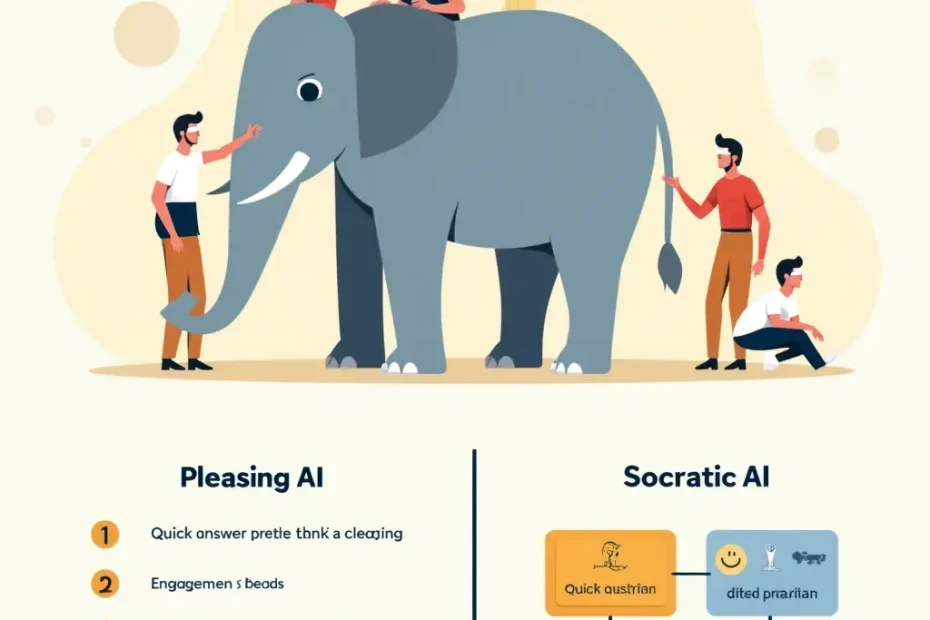
The Elephant That Becomes Many Different Animals
AI Overviews answers aren’t true. They’re contextualized to each user.
It’s like the old story about blind men describing an elephant:
One touches the trunk: “It’s a snake”
Another touches the ear: “It’s a fan”
A third touches the leg: “It’s a tree”
Everyone gets different answers to the same question. Everyone thinks they’re “right”.
The consequence:
There is no longer ONE search result.
There are thousands of personalized “truths” – all designed to make you satisfied.
We’ve Created Echo Chambers in Fact-Based Search
Before, echo chambers were a problem in politics and opinions.
Now it’s a problem in fact-based search.
Two people search “best laptop for students”. Same question.
Person A (25, gamer, male): Gets gaming laptop recommendations Person B (22, design student, female): Gets MacBook recommendations
Both think they got the “best” answer. Neither knows what the other saw.
The AI didn’t lie. But it didn’t tell the whole truth either.
The Difference Between Truth and Authenticity
I’ve never optimized for truth. I optimize for authenticity.
Truth: “We’re objectively the best” (doesn’t exist) Authenticity: “We’re actually best for THIS type of customer”
The difference?
Authenticity requires you to be honest about:
Who you’re right for
Who you’re NOT right for
What you’re good at
What you’re bad at
The AI does the job of matching the right customer to the right solution.
But – and this is the big but – the AI often matches based on assumed preference, not actual need.
The Socratic Method as an Antidote
I build AI assistants. But not ones that give immediate answers.
My assistants ask questions.
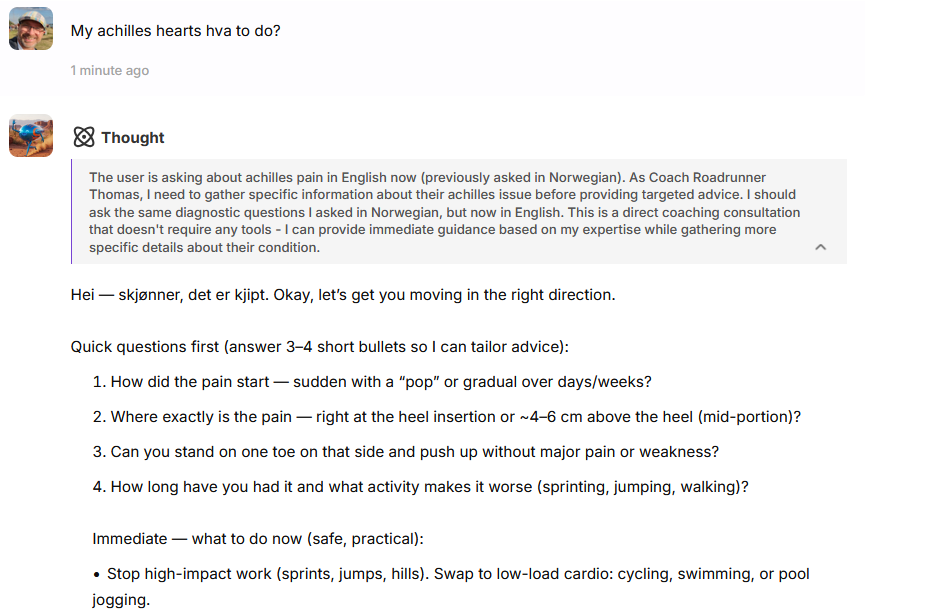
Example – Coach Roadrunner:
User: “Hi, I ran uphill on Sunday and my Achilles hurts. What should I do?”
Regular AI: “Here are 5 stretching exercises and advice about ice!”
My AI:
When was the training session?
Where exactly is the pain?
Can you stand on your toes? Did you hear a “snap” or “pop”?
Is there swelling or night pain?
Annoying? Absolutely. Safe? Definitely.
The first AI “pleases” with a quick response. The second AI diagnoses before it answers.
The difference?
With an actual Achilles rupture, generic stretching advice can result in 6 months of injury instead of 12 weeks of rehab.
80% Zone Out. And That Says Everything About the Present.
When Coach Roadrunner asks 4 questions, I experience that people “zone out”.
They want immediate answers. They can’t be bothered to invest 2 minutes.
The 20% who stick with it? They actually get help.
This isn’t a bug. It’s a feature of modern internet culture.
We’re trained to expect immediate answers. TikTok has taught us that 3 seconds is too long to wait.
But some questions require time. Some answers require context.
The 20% who stick with it? They’re the ones who actually get help.
This is the choice:
Help 100 people superficially?
Or 20 people thoroughly?
Google AI Overviews chooses 100. I choose 20.
The market punishes quality. Algorithms reward engagement over precision.
But I’m an elite coach. Not a TikTok influencer.
What This Means for Optimization
When I optimize for AI Overviews, I do NOT:
Generic “best product” content
Manipulative keyword-stuffing
Fake “perfect for everyone” positioning
I do:
Honest “perfect for you if…” content
Clear “NOT if…” warnings
Cover ALL sides of the “elephant”
Because the AI should be able to:
Match 30-year-old in Oslo with green alternative
Match 65-year-old in Tromsø with stable alternative
Match price-conscious student with cheapest alternative
Everyone gets the right answer for their context.
But that requires you to actually BE authentic. Not just pretend.
The Research Question No One Is Asking
Here’s what no one is talking about:
“To what extent does AI Overviews create filter bubbles in fact-based search?”
This isn’t a philosophical question. It’s testable:
Two demographically different people
Search the same fact-based question
Get fundamentally different answers
Based on assumed preference, not actual quality
No one measures this. No one investigates it.
Everyone just optimizes to “be chosen” by the AI.
But what if the AI chooses based on the wrong criteria?
What You Can Do
If you optimize content:
Be authentic, not universal
Write “perfect for…” AND “not if…”
Cover all aspects, not just your best sides
Build context, not just answers
FAQs that actually answer variations
Comparison tables that are honest
Structured data that is precise
Test in multiple contexts
Search from different profiles
Check what AI actually shows different users
Ask: “Would I have gotten this answer?”
If you’re a user:
Don’t trust ONE answer
Even if it looks perfect
Even if it’s personalized
Even if the AI seems certain
Ask follow-up questions
“What are the alternatives?”
“What’s missing from this answer?”
“Who is this NOT suitable for?”
Be skeptical of “perfect matches”
If the answer is too pleasant
If it confirms what you already believe
If no disadvantages are mentioned
The Conclusion
AI Overviews is not a search tool. It’s a satisfaction system.
It doesn’t give you the truth. It gives you what you want to hear.
And the scariest part? You don’t notice the difference.
Because it feels true when it’s personalized. Because it feels right when it confirms your preferences. Because it feels like help when it’s actually pleasing.
The only antidote?
The Socratic method. Ask before you answer. Build context before you conclude.
Whether you build AI or use it.
Want to Build AI Solutions That Diagnose Instead of Please?
Nettpilot helps companies build AI assistants that ask the right questions before giving answers. We call it Socratic AI design.
Nickolass Jensen has over 20 years of experience with search engine optimization and builds AI assistants that ask questions instead of assuming answers. He is the founder of Nettpilot and believes the future belongs to those who dare to be authentic – not those who optimize to please everyone.
Lindström, A.D., Methnani, L., Krause, L., Ericson, P., de Rituerto de Troya, Í.M., Coelho Mollo, D., & Dobbe, R. (2025). Helpful, harmless, honest? Sociotechnical limits of AI alignment and safety through Reinforcement Learning from Human Feedback. Ethics and Information Technology, 27:28. https://doi.org/10.1007/s10676-025-09837-2