
What Elite Sprint Coaches Teach Us About Optimizing AI Agents
The most expensive mistake in AI isn’t using the wrong model. It’s wasting tokens on bloated prompts that deliver mediocre results.
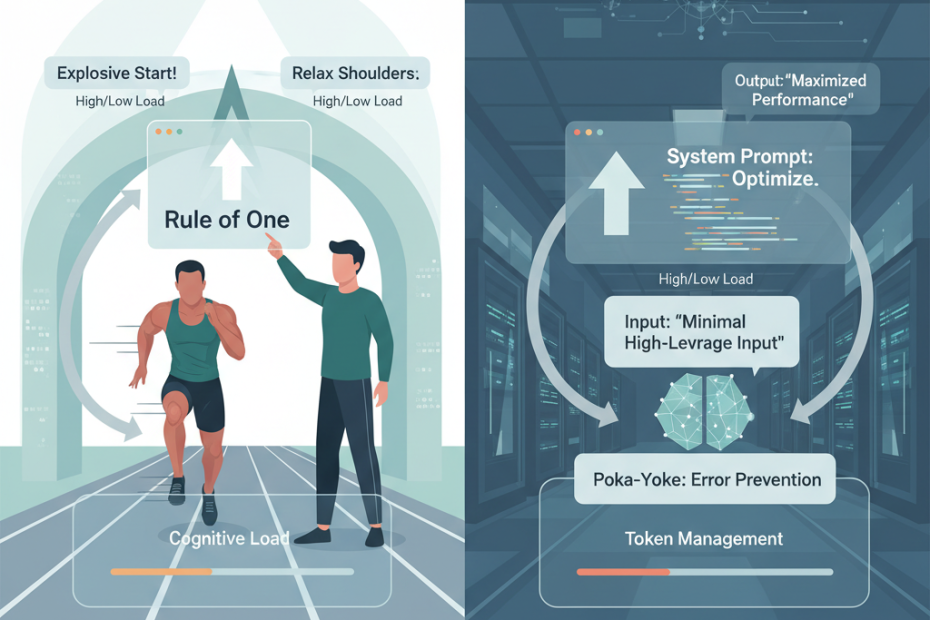
Elite sprint coaches and AI engineers face the same brutal constraint: maximizing performance from a finite, high-cost resource. For sprinters, it’s the Central Nervous System (CNS) and 10 seconds of explosive power. For AI agents, it’s the context window and token budget.
The breakthrough insight? Peak performance comes from precision, not volume.
The Hidden Cost of “Junk Miles” in AI
Charlie Francis, legendary sprint coach, built careers on one principle: never train at medium intensity. Medium-intensity running (75-95% effort) accumulates fatigue without triggering neural adaptation. It’s metabolically expensive and neurologically useless.
He called it “junk miles.”
Your AI prompts have the same problem.
Every vague instruction. Every irrelevant context. Every redundant token.
You’re burning money on computational “junk miles” that exhaust the model’s capacity without improving output quality.
The Real Cost:
- Financial: Unnecessary token consumption
- Performance: Attention drift and hallucinations
- Latency: Slower response times
- Reliability: System breakdown under complex tasks
The High/Low Framework: CNS Management Meets Cognitive Load Theory
Francis’s training split was ruthlessly simple:
High CNS Days: Maximum intensity sprints (95-100%). High neural activation. High adaptation.
Low CNS Days: Tempo runs (sub-75%). Active recovery. Tissue maintenance.
Medium Intensity: Eliminated. Pure waste.
This maps directly to Large Language Model (LLM) optimization:
| Sprint Training | AI Optimization | System Impact |
|---|---|---|
| High CNS Day (Max velocity) | Intrinsic Load (Complex reasoning, Chain-of-Thought) | Drives maximal output. High cost. |
| Low CNS Day (Tempo runs) | Low Load Tasks (Summarization, model right-sizing) | Promotes efficiency. Cost recovery. |
| Junk Miles (Medium intensity) | Extraneous Load (Vague prompts, irrelevant context) | Wastes resources without adaptation. |
| Active Recovery | Context Management (RAG, caching, compression) | Restores capacity for next high-demand task. |
The Rule of One: External Cueing and Attention Engineering
Dr. Gabriele Wulf’s research revolutionized coaching: External focus cues dramatically outperform internal focus cues.
Internal cue: “Push off the blocks with your feet.” (Focuses on body mechanics)
External cue: “Explode towards the finish line.” (Focuses on outcome)
Why? External cues consume less attentional demand, freeing cognitive resources for automatic execution.
The coaching mandate: Give ONE cue at a time. Multiple instructions fragment attention and destroy performance.
The AI Translation:
Your prompts must be externally focused and singular in priority.
Bad prompt (Internal focus, multiple demands):
Analyze this data, consider the context, think about edge cases,
format it properly, make it comprehensive but concise, and ensure
accuracy while being creative...
Good prompt (External focus, Rule of One):
Step 1: Identify the three highest-impact insights from this data.
Step 2: For each insight, provide one concrete action.
Step 3: Format as: Insight → Action → Expected Outcome.
The structured prompt creates attention scaffolding—distinct cognitive clusters that guide the model’s reasoning flow without forcing it to infer the logical structure.
The System Prompt: Your Athlete’s Blueprint
Glen Mills, Usain Bolt’s coach, obsessed over foundational technique. His philosophy: Master the first 30 meters or fail at 100 meters.
He identified Bolt’s unique biomechanical advantage—power generation in the hips—and built the entire training system around it. This persistent technical profile prevented deterioration under fatigue and pressure.
Your AI agent needs the same foundation: the system prompt.
The system prompt is your persistent instruction layer. It defines:
- Persona and tone
- Knowledge domain
- Output format
- Ethical guardrails
Crucially: It acts as the anti-deterioration protocol. When user prompts get complex or demanding, the system prompt stabilizes behavior and prevents “attention drift.”
Example System Prompt Architecture:
You are an executive-level technical analyst.
Core Rules:
1. Respond in 3 sections: Summary, Analysis, Recommendation
2. Use data to support every claim
3. Flag assumptions explicitly
4. Never use jargon without defining it first
When uncertain: State confidence level (High/Medium/Low)
When conflicting data exists: Present both sides, then recommend
This is your athlete’s technical blueprint. It doesn’t change with every workout—it’s the foundation that enables consistent performance.
Poka-Yoke: Engineering Error-Proof Execution
World-class coaches don’t just treat injuries—they design training environments to prevent them.
The AI equivalent is Poka-Yoke in Agent-Computer Interface (ACI) design: making errors impossible to commit.
Example:
If your agent frequently misinterprets relative file paths, don’t write better error messages. Redesign the tool to only accept absolute paths.
ACI Design Principles:
- Clear boundaries and constraints
- Detailed documentation with examples
- Anticipated edge cases
- Error-proof argument structures
The goal: Minimize extraneous cognitive load by eliminating opportunities for system failure.
The Reflection Loop: Technical Review and Self-Correction
Sprint coaches use HD cameras to review races frame-by-frame, providing immediate, precise feedback before the next training run.
AI agents use Reflection patterns (Nested Chat):
Step 1: Generate baseline response (Internal Response 1)
Step 2: Self-critique (Internal Prompt 2: “Check this for correctness. Provide constructive criticism.”)
Step 3: Revise based on feedback (Internal Prompt 3: “Improve the answer.”)
Step 4: Output final response
This multi-step process significantly increases accuracy because the model cannot self-critique during initial generation—just like a sprinter can’t feel technical flaws at maximum velocity.
The cost: Multiple LLM calls = higher token consumption.
The benefit: Dramatically reduced hallucinations and improved logical coherence.
Advanced methods like Chain-of-Verification (CoVe) formalize this:
- Generate baseline response
- Plan verification questions
- Answer verification questions independently
- Produce revised response incorporating verification
The 10-Second Prompt Philosophy
Elite sprinters have 10 seconds to execute flawlessly. Every input—every coaching cue, every training session—must be hyper-efficient and high-leverage.
Your AI prompts operate under the same constraint.
The Four Core Principles:
| Sprint Coaching | AI Optimization | Performance Impact |
|---|---|---|
| Individualization (Force-Velocity profiles) | System Persona & Tool Specification | Aligns with unique system capabilities |
| High/Low Training | Cognitive Load & Token Management | Prevents overload, maximizes quality |
| External Focus Cueing | Structured Prompting & Attention Scaffolding | Directs reasoning, minimizes overhead |
| Poka-Yoke & Injury Prevention | ACI Design & Error-Proofing | Minimizes system failure opportunities |
Context Engineering: The Future of AI Optimization
The future isn’t finding a “magic prompt.” It’s Context Engineering—designing dynamic, context-aware systems that deliver the right information, in the right format, at the right time.
This mirrors the evolution of sprint coaching from generic training blocks to individualized, metric-driven profiles.
The Mandate:
Your prompt must be so precise, so clear, and so minimal in cognitive overhead that the system—whether human athlete or AI agent—can execute maximally and reliably in the shortest possible time frame.
Zero waste. Maximum output.
The Brutal Truth
Most AI tools give you pleasant feedback: “Your score of 65/100 is a good start!”
We don’t.
A 65/100 means you’re losing 35% of potential performance to competitors. It means your prompts are bloated with junk miles. It means you’re burning tokens without triggering adaptation.
The Three-Layer Approach doesn’t optimize for pleasantness. It optimizes for mastery.
We tell you:
- THE ONE highest-leverage fix
- Exact templates to execute it
- Measurable outcomes to track improvement
No generic advice. No equal-priority lists. No “consider improving…”
Just precision engineering for peak performance.
Ready to Stop Wasting Tokens?
The 10-second prompt isn’t about speed. It’s about efficiency—maximizing output quality while minimizing resource consumption.
It’s the difference between training smart and training hard.
It’s the difference between a 65/100 and a 95/100.
Start your audit: threelayerapproach.com
Download the full whitepaper: The 10-Second Prompt: Sprint Coaching Meets AI
Developed by Nickolass Jensen / Nettpilot
Tested in practice. Shared openly.
Contact: hello@threelayerapproach.com