

In the rapidly evolving digital landscape of 2026, SEO and Google Ads strategies must adapt to new realities shaped by AI, automation, and changing user behavior. At Nettpilot, we apply the Three-Layer Approach™ (3LA) to optimize content and digital presence for humans, search engines, and AI agents simultaneously. This article summarizes the most relevant SEO and Google Ads news and actionable insights, structured according to the 3LA framework.
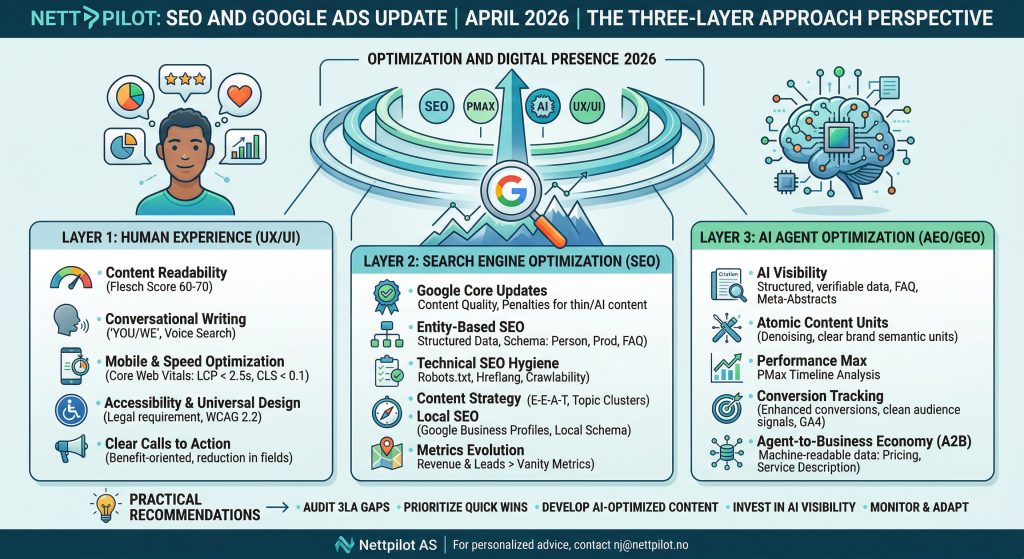
Layer 1: Human Experience (UX/UI)
- Content Readability and Engagement: Complex content leads to higher bounce rates. Use the Flesch Reading Ease formula to target a score of 60-70 (8th-9th grade level) for general audiences. Improve readability by using short sentences, simple words, active voice, bullet points, subheadings every 300 words, and examples or analogies.
- Conversational Writing: Use personal pronouns (you, we), ask questions, use contractions, vary sentence length, and include transitional phrases to make content more engaging and natural, especially for voice search optimization.
- Mobile and Speed Optimization: Prioritize Core Web Vitals (LCP < 2.5s, CLS < 0.1, INP/FID improvements). Test on mobile devices and fix critical issues quickly to improve user experience and reduce bounce.
- Accessibility and Universal Design: From 2026, universal design is legally required for Norwegian e-commerce sites. Follow WCAG 2.2 standards to ensure accessibility, including keyboard navigation, alt texts, color contrast, and responsive design.
- Clear Calls to Action (CTAs): Place prominent CTAs above the fold, use benefit-oriented and urgent language, and reduce form fields to increase conversions.

Layer 2: Search Engine Optimization (SEO)
- Google Core Updates: The March-April 2026 core updates emphasize content quality, relevance, and penalize thin or AI-generated content without editorial value. Monitor rankings carefully and avoid drastic changes during rollout.
- Entity-Based SEO and Structured Data: Build clear entity relationships using consistent names and schema markup (Person, Organization, Product, LocalBusiness, FAQ, BreadcrumbList). This improves Google’s understanding and indexing.
- Technical SEO Hygiene: Maintain crawlability with proper robots.txt, sitemap.xml, canonical tags, hreflang, and fix broken links. Use tools like Screaming Frog and Surfer SEO for audits.
- Content Strategy: Refresh high-value pages to demonstrate Experience, Expertise, Authoritativeness, and Trust (E-E-A-T). Prune or merge thin content and use topic clusters with strong internal linking.
- Local SEO: Optimize Google Business Profiles with accurate NAP (Name, Address, Phone), categories, reviews, and local landing pages with schema.
- SEO Metrics Evolution: Move beyond vanity metrics like average position and domain authority. Focus on revenue, leads, and business outcomes.
Layer 3: AI Agent Optimization (AEO/GEO)
- AI Visibility: AI agents prioritize structured, verifiable, and semantically clear content. Optimize for AI-generated answers by providing FAQ sections, meta-abstracts, and semantic clarity.
- Atomic Content Units (ACUs): Reduce low-value or irrelevant content to improve brand clarity and AI engagement. The ‘Great Denoising’ approach helps focus on content that AI agents trust and cite.
- Performance Max (PMax) Campaigns: Use Google Ads’ new channel performance timeline to analyze AI-driven campaign effectiveness across Search, YouTube, and Display.
- Conversion Tracking and Signal Quality: Ensure GA4 and server-side tagging are integrated. Use enhanced conversions and maintain clean audience signals to improve AI bidding and targeting.
- Agent-to-Business (A2B) Economy: Prepare your business for AI agents acting autonomously by providing machine-readable, structured, and verified data (e.g., pricing tables, service descriptions). If your data is not machine-readable, you risk invisibility in AI-driven purchasing decisions.
Practical Recommendations
- Audit your site and campaigns using the Three-Layer Approach: Identify gaps in UX, SEO, and AI readiness.
- Prioritize quick wins: Improve page speed, fix technical SEO basics, and add structured data.
- Develop AI-optimized content: Use BLUF, add FAQs, clear entity relationships, and semantic clarity.
- Invest in AI visibility: Structure your pricing and service data for AI agents.
- Monitor and adapt: Use Google Search Console, AI visibility tools, and Google Ads channel insights.
The digital marketing landscape in 2026 demands a holistic approach that balances human experience, search engine requirements, and AI agent optimization. Nettpilot’s Three-Layer Approach™ provides a proven framework to thrive in this environment. By focusing on readability, technical SEO, and AI-friendly content, businesses can increase visibility, engagement, and conversions.
For personalized advice or to discuss how to implement these strategies for your business, contact Nickolass Jensen at nj@nettpilot.no.
📚 References:
– Three-Layer Approach Metrics Guide, Nettpilot
– Google Search Central Blog, April 2026
– Search Engine Land, March-April 2026 Updates
– Moz Whiteboard Friday, 2026 SEO Tips
– Nettpilot Blog and Case Studies
This article is prepared by Nettpilot AS, combining latest industry insights with the Three-Layer Approach™ methodology for optimal digital presence.