
Abstract
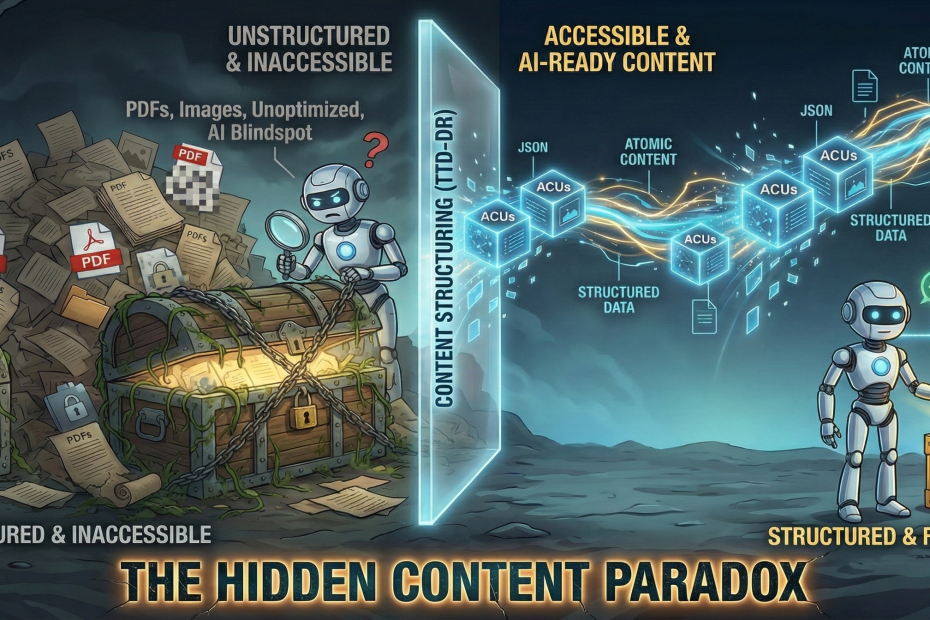
This article identifies and defines The Hidden Content Paradox , a critical structural conflict emerging in the transition from traditional Search Engine Optimization (SEO) to Generative Engine Optimization (GEO).
The paradox posits that modern User Experience (UX) design principles – specifically the use of dynamic elements like accordions, tabs, and client-side rendering to declutter interfaces for humans (Layer 1) – inadvertently render critical information invisible to the Large Language Model (LLM) agents now acting as primary information intermediaries (Layer 3).
Drawing on data regarding the computational constraints of AI crawlers, we demonstrate that while traditional search engines like Google may render JavaScript-heavy content, many AI agents prioritize First-View Content found in the raw Response HTML.
This discrepancy creates a “blind spot” where a brand’s most valuable data remains inaccessible to the very systems attempting to answer user queries.
This whitepaper1 proposes the Three-Layer Approach™2 (3LA) as a remediation framework.

Introduction
The Invisible Web For the last decade, the directive for digital architects has been clear: Declutter. We have been taught to prioritize mobile responsiveness and clean design. We hide complex technical specifications behind “Read More” buttons, tuck lengthy FAQs into neat accordions, and load reviews dynamically to speed up initial page load times.
For the human user (Layer 1), this is excellent design. It reduces cognitive load and improves engagement.
But for the AI Agents that are rapidly becoming the internet’s primary gatekeepers (Layer 3), this design philosophy is an obstruction.
Defining the Paradox We are witnessing a fundamental divergence in how humans and machines consume the web. This is The Hidden Content Paradox:
The very design elements used to improve the human experience are simultaneously degrading the machine experience, rendering critical business intelligence invisible to Answer Engines.
The root of this paradox lies in the mechanics of retrieval. While traditional search crawlers like Googlebot, bingbot and yandexbot (Layer 2), have spent years perfecting the ability to render JavaScript and “see” a page like a human does, the new generation of LLM crawlers often operates under stricter “energy budgets”.
To generate answers in real-time, many of these agents rely on Response HTML—the raw code delivered by the server, rather than the Rendered HTML that appears after JavaScript execution. If your pricing, your unique selling proposition, or your technical data requires a “click” or a “script” to appear, it might as well not exist.
The Consequence: The Zero-Click Void
This is not a theoretical problem. When an AI like ChatGPT or Perplexity fails to “see” your hidden content, it doesn’t just rank you lower. It hallucinates. It fills the gap with data from your competitors who have made their content accessible.
As we transition from a Human-to-Business (H2B) economy to an Agent-to-Business (A2B) economy, visibility requires a new architecture. It requires a strategy that serves the Human, the Crawler, and the Agent simultaneously.
We call this The Three-Layer Approach™ (3LA).
The data: What AI Overviews are doing to CTR
The shift is no longer theoretical. Multiple large-scale studies now quantify the CTR impact of AI-generated answers in search results:
- –58% CTR for position-one content when an AI Overview is present, based on Ahrefs’ analysis of 300,000 keywords (December 2025) — up from –34.5% in their earlier 2025 study.
- –61% organic CTR across 3,119 informational queries at 42 organizations, per Seer Interactive’s September 2025 study (from 1.76% to 0.61%).
- Only 1% of searches result in users clicking a link within an AI Overview (Pew Research Center, July 2025).
- 58% of all Google searches now end with zero clicks (SparkToro, 2025).
- AI Overviews now appear in 48% of all tracked queries – up from 31% a year earlier (BrightEdge, February 2026).
But the data also reveals a clear survival path: brands cited inside AI Overviews earn 35% more organic clicks and 91% more paid clicks compared to non-cited brands on the same queries (Seer Interactive, 2025). Citation is the new ranking.
This is the operational reality of the Hidden Content Paradox: content that cannot be read by AI crawlers cannot be cited — and content that is not cited suffers the full force of the CTR collapse.
Sources
AIO Impact on Google CTR: September 2025 Update | Seer Interactive
Update: AI Overviews Reduce Clicks by 58% | Ahrefs, February 2026
Google AI Overviews Surge 58% Across 9 Industries | ALM Corp, March 2026
Technical Solutions: Resolving the Conflict
To solve The Hidden Content Paradox, we do not need to sacrifice User Experience. We need to stop hiding our content from the machines that now control the traffic. We must build for Layer 3 (The AI Layer).
Here is your reality check.
1. Identify the “Hiders”
Modern web design is full of traps that make a website look polished to a human (Layer 1) while rendering it invisible to an AI agent (Layer 3). Even if your site looks perfect in a browser, the “Response HTML” code often looks empty to a bot.
The typical culprits are:
- Tabs: Only the active tab is visible in the source code; the rest is hidden.
- Accordions: Collapsed content that requires a click to exist in the DOM.
- Modals/Popups: Content that does not load in the initial HTML.
- Lazy Loading: Text or elements that do not load until a user scrolls.
- JavaScript-Rendered Content: Critical info generated by client-side scripts.
The Consequence is Brutal:
- For Humans: Looks great. ✅
- For Google: Works OK (Googlebot can usually execute JavaScript). ⚠️
- For AI Crawlers: Completely invisible. ❌
2. The Concrete Example: The FAQ Trap
Let’s say you have a fantastic FAQ section wrapped in a sleek accordion design. Humans love the overview. But an AI agent like ChatGPT, operating on a strict energy budget, only “sees” the headers in the raw HTML response, not the answers hidden behind a script.
The Result? The AI can read the question, but it cannot find the answer*. You are not cited. Your competitor, who serves the answer openly, wins the recommendation.
3. The 3LA Solution: From Hidden to Semantic
We must shift from design that “hides” to code that “explains.” The solution is to use semantic HTML that functions across all three layers simultaneously.
BEFORE 3LA (The Old Way)
CSS or JavaScript hides the content. The AI agent sees only an empty box.
<div class="accordion" style="display:none">
  Critical content here that the AI misses...
</div>
AFTER 3LA — Step 1: Semantic HTML
The HTML5 <details> element keeps content visually collapsed for humans (Layer 1) but always present in Response HTML for AI crawlers (Layer 3).
<details>
  <summary>What does the service cost?</summary>
  <p>The service costs $50 per month, including setup and support.</p>
</details>
AFTER 3LA — Step 2: FAQPage Schema (JSON-LD)
Semantic HTML makes content accessible to AI crawlers. JSON-LD schema makes it understandable — giving AI agents structured context about what the content means, not just what it says.
<script type="application/ld+json">
{
  "@context": "https://schema.org",
  "@type": "FAQPage",
  "mainEntity": [
    {
      "@type": "Question",
      "name": "What does the service cost?",
      "acceptedAnswer": {
        "@type": "Answer",
        "text": "The service costs $50 per month, including setup and support."
      }
    }
  ]
}
</script>
The <details> element solves the visibility problem: content exists in Response HTML. The FAQPage schema solves the comprehension problem: AI agents understand the question-answer relationship without needing to infer it from surrounding context. Both layers are required for full Layer 3 compliance.
Key distinction: A crawler that reads your <details> element knows what your content says. A crawler that reads your JSON-LD knows what your content means. The 3LA requires both.This is a minor change in code, but a massive shift in visibility.
4. Why This Is Critical Right Now
This is not a theoretical exercise for the future. The shift has already happened.
- 58% of consumers have already replaced traditional search engines with Gen AI tools for product recommendations * according to Cap Gemini3.
- 73% of purchase decisions are now influenced by AI-generated answers.
The math is simple: If the AI doesn’t see your content, you do not exist in the purchasing process.
5. Verify Your Reality
Do not guess whether you are visible. Check it.
We have developed a tool that allows you to see your website through the eyes of an AI crawler. At threelayerapproach.com, you can run an analysis that shows exactly what AI crawlers see versus what humans see on your site.
Fix the code. Be seen.
3la: A framework for holistic content optimization in the AI era
What you get in the whitepaper
- 11-page educative whitepaper with in-depth analysis
- Practical implementation guide in 3 phases
- Case study with real results (+46% traffic)
- Technical details about llms.txt and AI optimization
- Success measurement framework across all 3 layers
Data-driven framework based on thousands of hours analyzing real search data, practical SEO work, and extensive AI model testing.
Developed by Nickolass Jensen / Nettpilot
🔄 Update — April 2026
Since this article was published, the Hidden Content Paradox has become significantly more urgent. The Model Context Protocol (MCP), launched by Anthropic in November 2024, has emerged as the de facto standard for connecting AI agents to external tools and data sources.
The numbers are striking: MCP server downloads grew from roughly 100,000 in November 2024 to over 97 million monthly SDK downloads by late 2025. OpenAI, Google, Microsoft, and AWS all adopted the standard within months. In December 2025, MCP was donated to the Linux Foundation, cementing its status as a vendor-neutral industry standard.
What this means for the Hidden Content Paradox: AI agents operating via MCP do not render JavaScript. They consume raw Response HTML – or structured API responses – directly. Content hidden behind tabs, accordions, or client-side scripts is completely invisible to this entire class of agent.
Gartner projects that 40% of enterprise applications will include task-specific AI agents by end of 2026, up from less than 5% today. The window for fixing hidden content architecture is narrowing fast.
Sources: The text is based on findings in these original documents:
73% of Shoppers Using AI in Shopping Journey | But Merchants Face New Agentic Commerce Risks
Based on a global survey of more than 5,000 consumers, the research reveals a defining moment for ecommerce: nearly three in four shoppers (73%) are already using AI in their shopping journey. Shoppers are embracing AI assistants like ChatGPT for product ideas (45%), to summarize reviews (37%), and to compare prices (32%).
https://www.morningstar.com/news/business-wire/20251020127097/global-study-73-of-shoppers-using-ai-in-shopping-journey-but-merchants-face-new-agentic-commerce-risks
AI-optimalisering for bedrifter: Slik leder du i 2026 — Nettpilot
Internal methodology validation: nettpilot.no ranked #1 in Google AI Mode for “ai optimalisering for bedrifter” following 3LA implementation. Case documented by Nettpilot AS, April 2026.
https://nettpilot.no/ai-optimalisering-for-bedrifter/
- The AI Middleman
A comprehensive strategic report detailing the shift from Human-to-Business (H2B) to Agent-to-Business (A2B), the dominance of bot traffic (nearly 50%), and the definition of Generative Engine Optimization (GEO).
(Whitepaper by Nickolass Jensen, 2025) ↩︎ - The Three-Layer Approach
A Framework for Holistic Content Optimization in the Age of Generative AI A whitepaper by Nickolass Jensen (Nettpilot AS) defining the Three-Layer Approach™ (3LA), the Hidden Content Paradox, and technical specifications for llms.txt and semantic HTML to make content visible to AI agents.
https://threelayerapproach.com ↩︎ - What Matters to Today’s Consumer | Capgemini Research Institute
Global consumer trends report finding that 58% of consumers have replaced traditional search engines with Gen AI tools for product and service recommendations, up from 25% in 2023. Published January 9, 2025.
https://www.capgemini.com/news/press-releases/71-of-consumers-want-generative-ai-integrated-into-their-shopping-experiences/ ↩︎
Strategisk veileder til AI-kodeverktøy for norske byråer i 2025
A guide analyzing AI coding tools (GitHub Copilot, Cursor, etc.) specifically for the Norwegian market, focusing on data sovereignty and privacy.
https://nettpilot.no/guide-til-ai-kodingsverktoy-for-norske-byraer-og-konsulenter/
AI -overviews perspektivtesting research proposal
A draft proposal for a collaboration project between Nettpilot, Høgskulen i Volda, and USN to research AI search variations and develop an “AI Search Reality Audit™”.
(Proposal by Nickolass Jensen, 2025 – book meeting with Nickolass)
The Rise of MCP: Protocol Adoption in 2026 | Medium / MCP-Server
Overview of MCP ecosystem growth: 97 million monthly SDK downloads by November 2025, 10,000+ servers indexed, and donation to Linux Foundation in December 2025.
https://medium.com/mcp-server/the-rise-of-mcp-protocol-adoption-in-2026