
The short answer
The Three-Layer Approach™ (3LA) is a content optimization framework built on a single observation: Your content is now read by three fundamentally different audiences simultaneously, and most sites are invisible to at least one of them.
The three layers are:
- L1 — Human/UX: Can a human reader understand, trust, and act on this content?
- L2 — Search/SEO: Can a crawler index, parse, and rank this content?
- L3 — AI/GEO: Can a large language model extract, verify, and cite this content?
Traditional SEO addresses L1 and L2. The frameworks most consultants use today still stop there. The problem is that AI-powered search — ChatGPT, Perplexity, Claude, Gemini, Bing Copilot — operates on a third logic entirely. A site can have excellent UX and strong Google rankings and still be completely invisible to AI citation. That gap is what 3LA was built to close.
3LA is not a measurement framework. It is a diagnostic and remediation framework. It tells you what to fix, not just what to report.
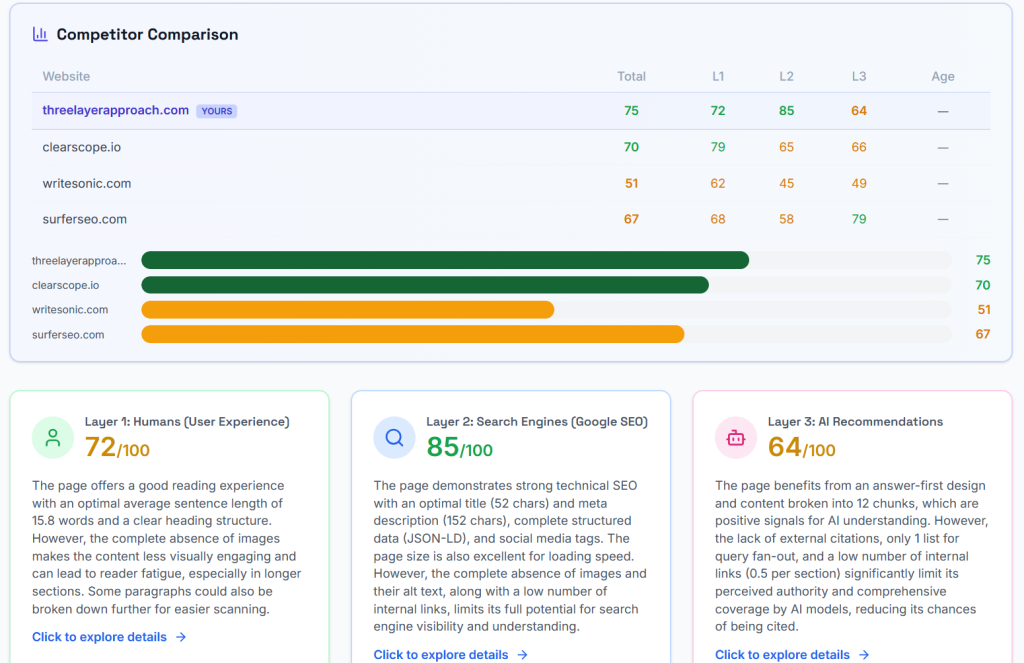
Threelayerapproach.com scores 75/100 total – ahead of clearscope.io (70), surferseo.com (67), and writesonic.com (51).
Layer breakdown:
L1 Human/UX 72/100 (strong sentence length at 15.8 words, clear heading structure; gap: no images),
L2 Search/SEO 85/100 (optimal title tag 52 chars, complete JSON-LD, fast load; gap: low internal link count),
L3 AI/GEO 64/100 (answer-first design, 12 content chunks; gap: only 1 external citation, 0.5 internal links per section — limits AI query fan-out coverage).
Source: Threelayerapproach.com audit tool.
Why three layers – the origin
In late 2024, a pattern appeared in our data at Nettpilot that didn’t fit the existing model.
Pages with strong Google rankings – pages that had been properly optimized for both UX and technical SEO – were generating zero AI citations. Not few citations. Zero. Meanwhile, a handful of structurally simpler pages on the same domains were being cited repeatedly by ChatGPT and Perplexity.
The difference wasn’t content quality. The difference was structure.
The pages that AI models cited had their critical information in the initial HTML response – not hidden in accordions, tabs, or JavaScript-rendered elements. They were written in a question-answer format that mapped directly to how LLMs extract knowledge. They contained factual markers (“according to,” “research shows”) and clear entity signals. The pages that ranked well on Google but received zero citations were, from an LLM’s perspective, opaque.
This observation led to a hypothesis: content optimization requires three distinct layers, each serving a different reader with different requirements. Improving one layer must not degrade the others — but the three layers are not the same thing, and conflating them is a strategic error.
The Three-Layer Approach™ was the formalization of that hypothesis.
How the framework developed – a documented timeline
The evolution from initial hypothesis to the current framework is documented in published materials:
October 16, 2025 – The Three-Layer Approach™ whitepaper v1 published. L1 Human / L2 Search Engines / L3 AI Agents established as the core structure. The Hidden Content Paradox and Citation Gap named as primary challenges.
“The Three-Layer Approach is a trademark of Nettpilot AS” declared on first publication. (threelayerapproach.com/whitepapers)
October 17, 2025 – Case study published on botcamp.no documenting the platform build: “The Three-Layer Approach — Et AI-drevet SEO Audit-verktøy bygget på rekordtid.” (botcamp.no/3la-bygging-av-softwareplattform-pa-en-uke)
Q4 2025 – CFR (Citation Frequency Rate) formalized as the primary L3 metric. L2 terminology refined from “Crawler” to “Search/SEO” to reflect the broader scope beyond pure crawlability. Dark Opportunities identified as a diagnostic category. LayerScore weighting established: L1 30% / L2 40% / L3 30%.
January 2026 – “The Great Denoising” published on nettpilot.com, introducing the Atomic Content Unit (ACU) as the fundamental building block of L3-optimized content. Case: Nettpilot deliberately purged high-volume, low-relevance traffic to clarify the entity signal that LLMs were constructing about the brand. (nettpilot.com/the-great-denoising)
Q1 2026 – Majestic.com “SEO in 2026” podcast recorded with David Bain (~2.5 hours). BrightonSEO pitch submitted. CFR dataset initiated across 14 Norwegian domains.
April 2026 – “The Context Wars” working paper published, formalizing the theoretical architecture behind L3: Atomic Content Units, the TTD-DR (Test-Time Diffusion Deep Researcher) consumption model, Context Flywheel dynamics, and the economic case for L3 via context caching. (threelayerapproach.com)
April 23, 2026 – Aleyda Solis publishes independently: “A 3 Layer Framework to Measure AI Presence, Readiness and Business Impact.“ 189 days after the first 3LA publication. (See below for the distinction.)
May 2026 – CFR dataset complete: 14 Norwegian domains, 7,494 pages, 26.2 million GSC impressions, 24,159 AI citations (Bing Webmaster Tools). 5.2× CFR difference between 3LA-optimized and non-optimized domains documented. 2,884 Dark Opportunities identified. nettpilot.com ranking position 1–2 globally on ACU/BLUF terms.
The three layers explained
L1 – Human/UX: the foundation of trust
Layer 1 is the layer of the human reader. It governs readability, trust signals, information architecture, and conversion design. If a human cannot understand and trust the content, the page fails its primary purpose regardless of how well it performs on L2 or L3.
Key L1 criteria: Flesch reading ease (target 60–70 for general audiences), sentence length, visual hierarchy, above-the-fold information placement, mobile experience, and E-E-A-T markers – author attribution, first-person experience signals, demonstrable expertise.
L1 is not optional in an AI-first world. AI agents may synthesize the answer, but a human still finalizes the transaction. And Google’s E-E-A-T signals – drawn from L1 markers – influence the credibility signals that L3 alone cannot establish.
L2 – Search/SEO: the discovery infrastructure
Layer 2 is the layer of the crawler. It governs technical SEO, structured data, semantic HTML, internal linking architecture, Core Web Vitals, and keyword strategy.
L2 is the entry ticket. Before an AI agent can read content, it must find it – and L2 ensures discoverability through the same pipelines that populate LLM training sets and RAG retrieval indices. Strong L2 guarantees presence. It does not guarantee citation or influence.
The most common strategic error in GEO today is treating L3 as an extension of L2 – adding schema markup and calling it AI optimization. Schema is L2. What it enables for AI parsing is L3. They are separate layers with separate functions.
L3 – AI/GEO: the citation layer
Layer 3 is the newest and least understood layer. AI agents — whether ChatGPT, Perplexity, Claude, or Gemini — do not rank content. They extract, synthesize, and cite it. This requires a fundamentally different optimization logic.
The six structural requirements for L3 visibility:
- First-view accessibility – all critical content must exist in the initial HTML server response. Content loaded via JavaScript, hidden in accordions, or requiring user interaction is invisible to AI crawlers that read only the raw HTML.
- Chunk optimization -— content structured in discrete sections of 100–150 words, each addressing a specific question. AI models process content in chunks; amorphous prose forces expensive token parsing.
- Answer-first design – pages with question-format headings (“What is X?”, “How does Y work?”) are systematically more citable. The question acts as a semantic anchor for the LLM’s extraction process.
- Semantic richness – internal linking creates the knowledge graph that helps AI understand a domain’s full expertise. 8–12 contextually relevant internal links per page is a sound heuristic.
- Citation-worthiness – factual markers, external citations, primary data, and authoritative framing increase citation probability. AI agents are trained to prefer citable sources over marketing prose.
- llms.txt implementation – a machine-readable index at the domain root that tells AI agents precisely where high-value content resides, eliminating the need to parse visual clutter.
The most important L3 concept is the Atomic Content Unit (ACU): the smallest, indivisible unit of information that retains independent meaning and validity. An ACU is self-describing — it contains both the data (the fact) and the metadata (the semantic context). Building L3 means building a knowledge graph of interconnected ACUs, not writing pages.

The metrics 3LA introduced
CFR – Citation Rate
CFR = AI Citations / Search Impressions × 100
The primary L3 performance metric. CFR can exceed 100% (a page receiving more AI citations than GSC impressions is being cited from outside its search-visible surface). In the 14-domain dataset: peak CFR on optimized pages reached 0.644% (elitesprinttrening.no, where 1 optimized page accounts for 94% of all domain citations). Non-optimized bottom: 0.013%. The 5.2× difference between 3LA-optimized and non-optimized domains is the clearest quantitative proof of the framework’s effect.
Pages with high GSC impressions (strong L2 visibility) and zero AI citations (invisible at L3). These are the highest-priority intervention targets — the structural work is done, the audience exists, and the L3 gap alone is preventing citation. 2,884 Dark Opportunities identified in the current dataset across 14 domains.
A composite score weighting the three layers: L1 30% / L2 40% / L3 30%. L2 receives the highest weight because discoverability is the prerequisite for the other two layers to function. The 3LA audit at threelayerapproach.com calculates LayerScore for any URL in approximately 45 seconds.
Proof Gap components: SPG / TGG / CRG
Structural Proof Gap (SPG) – missing schema, incorrect entity signals, no structured data. Textual Grounding Gap (TGG) — content that lacks the factual markers and citation-worthy framing that LLMs use to assess authority. Consistency & Redundancy Gap (CRG) – entity signals that conflict across pages, domains, or external profiles (Wikipedia, LinkedIn, review sites).
What the data shows – 14-domain study
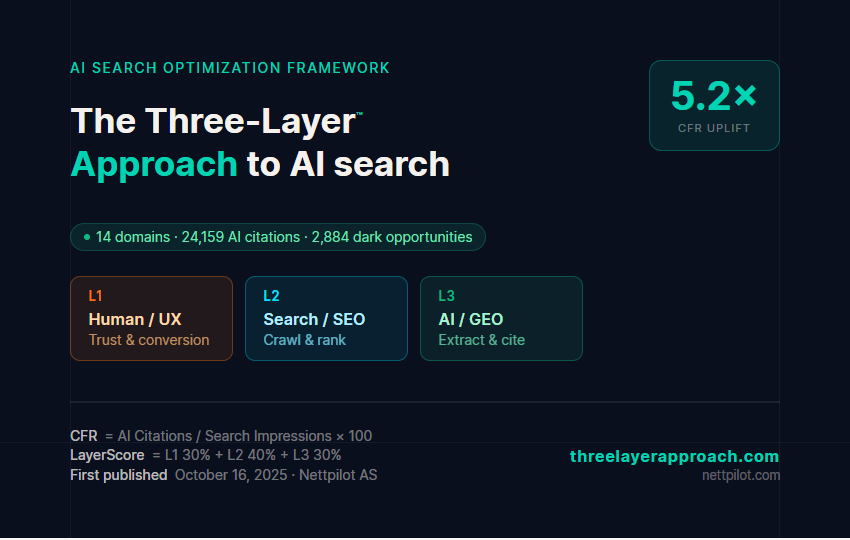
- 7,494 pages analyzed
- 26.2 million GSC impressions
- 24,159 AI citations (source: Bing Webmaster Tools AI Performance Report)
- 2,884 Dark Opportunities identified
- CFR range: 0.013% (zero L3 optimization) to 0.644% (full L3 implementation)
- 5.2× average CFR difference between 3LA-optimized and non-optimized domains
Key finding: elitesprinttrening.no – a single page, fully optimized for L3 – accounts for 94% of all citations across the entire domain. This is the ACU effect in practice: one structurally precise, citation-worthy page outperforms an entire unoptimized site on L3.
Secondary case: energipakka.no achieved a 10.5% conversion rate on AI-referred traffic versus 1.4% on organic traffic. AI-cited visitors arrive with higher intent because the citation itself functions as a pre-qualifying recommendation.
The primary case study – nettpilot.com ranking position 1–2 globally on ACU/BLUF (Bottom Line Up Front) terms – demonstrates that L3 optimization can produce category-defining citation rates even on competitive topics. CFR on target pages exceeds 200%, with +503% citation growth from January to April 2026.
This dataset forms the empirical core of the SSRN Working Paper v0.1: “Citeability as Search Currency” (in progress).
How 3LA differs from other frameworks in the market
The Solis framework – a note on independent parallel development
In April 2026 – 189 days after the first Three-Layer Approach™ whitepaper was published – Aleyda Solis, one of the most widely read voices in international SEO, published her own three-layer framework: “A 3 Layer Framework to Measure AI Presence, Readiness and Business Impact.”
The frameworks share a name and a shared conviction that AI search requires structured thinking across more than one dimension. They do not share a methodology, a use case, or an intended user.
Her layers are measurement stages – Presence, Readiness, Business Impact — designed to help teams report AI visibility performance to marketing leadership and CFOs. Her framework answers: “How do I measure and report AI search impact?”
Our layers are optimization domains – Human, Search, AI — designed to help practitioners diagnose why content fails to get cited and fix it at the structural level. 3LA answers: “Why is my content invisible to AI, and what do I build to fix it?”
Put directly: 3LA tells you what to build. Her framework tells you how to report the results. A complete AI search practice needs both, and they complement each other without conflict.
We would consider the parallel development a compliment. When two practitioners working independently on the same problem reach for a three-layer metaphor, it suggests the problem genuinely has three dimensions. Great minds, it seems, reach for similar structures when confronting the same reality — and that is a sign the structure is right.
No plagiarism. No overlap. Independent convergence on a shared insight.
Other tools in the market
Tools like Surfer SEO, Clearscope, and Rankability address L2 content optimization with significant depth. They do not measure L3. Monitoring tools like Otterly.ai and Profound.ai measure AI citation presence (a component of what 3LA calls the L3 diagnostic layer) but do not score L1 or L2, and do not provide the structural remediation logic that connects citation gaps to fixable content decisions.
3LA is the only framework that scores all three layers simultaneously and maps the gaps to specific, actionable interventions at each layer. The audit at threelayerapproach.com delivers this in 45 seconds for any URL.
What good L3 results actually look like
The results from the 14-domain dataset are not theoretical. They are production data from live Norwegian business domains, measured against Bing Webmaster Tools AI Performance Reports and Google Search Console.
The pattern that emerges consistently:
- Pages optimized for L3 (ACU structure, answer-first design, first-view accessibility) achieve CFR multiples of 5–10× versus comparable unoptimized pages on the same domain.
- Dark Opportunities – high-impression, zero-citation pages – respond rapidly to L3 intervention. In the Nettpilot property cluster, Citation Rate increased from under 2% to over 12% within 60 days of L3 optimization on targeted Dark Opportunity pages.
- AI-referred conversion rates consistently outperform organic conversion rates on equivalent commercial pages. The citation functions as a trust proxy.
- Entity clarity improvements (resolving CRG – Consistency & Redundancy Gap) affect AI citation accuracy across all platforms simultaneously, not just one.
The Context Flywheel effect: being cited increases the probability of future citations. The agent’s implicit preference for low-friction, high-signal sources compounds. Early L3 investment creates a structural moat that volume-based L2 competitors cannot easily replicate.
FAQ
Is the Three-Layer Approach the same as Aleyda Solis’s 3-layer framework?
No. They share a name and an intuition that AI search has multiple dimensions. The methodologies are entirely distinct. 3LA (published October 2025) is an optimization framework: L1 Human, L2 Search, L3 AI — telling practitioners what to build and fix. Solis’s framework (published April 2026) is a measurement framework: Presence, Readiness, Business Impact — telling marketing teams how to report AI visibility to leadership. They address different stages of the same workflow and are complementary.
Does 3LA replace traditional SEO?
No. L2 (Search/SEO) is an explicit and weighted component of 3LA. The framework argues that L2 is the prerequisite — you cannot be cited if you cannot be found. What 3LA adds is the diagnostic layer above L2 that most SEO tools do not address. Strong L2 guarantees presence. L3 determines whether that presence translates to citation and influence.
What is CFR and how is it different from rankings?
CFR (Citation Frequency Rate) measures how often AI systems cite your content relative to your Google search visibility. A page that ranks well but receives zero AI citations has a CFR of 0% — it has L2 visibility but no L3 conversion. A page that ranks modestly but receives heavy AI citation can have a CFR above 100%. Rankings measure L2. CFR measures L3. They are not substitutes.
Which AI platforms does 3LA optimize for?
The 3LA audit measures citation rate across ChatGPT, Claude, and Gemini on every audit. Brand Analyzer and Citation Tracker extend coverage to Perplexity and Mistral for full five-model visibility. The structural optimizations (first-view accessibility, ACU structure, answer-first design, semantic markup) improve citation probability across all major platforms simultaneously because they address the underlying mechanics of how LLMs extract and evaluate content — mechanics that are architecturally similar across models.
Where do I start?
Run a free 3LA audit at threelayerapproach.com. Three trial credits, no credit card required. The audit scores any URL across L1, L2, and L3 in approximately 45 seconds and returns a prioritized action list. For Norwegian businesses seeking a full GEO and SEO strategy, contact Nettpilot at nettpilot.com.
Nickolass Jensen is the founder of Nettpilot AS, a Norwegian digital consultancy with 25+ years of SEO experience, and the creator of the Three-Layer Approach™. He has been working on AI search optimization since 2024 and presented on GEO methodology on the Majestic.com “SEO in 2026” podcast. The Three-Layer Approach™ is a trademark of Nettpilot AS.
References:
Three-Layer Approach Whitepaper v1 (October 2025)
The Great Denoising, nettpilot.com (January 2026) ·
The Context Wars working paper (April 2026) ·
SSRN Working Paper v0.1: “Citeability as Search Currency” (in progress)
Bing Webmaster Tools AI Performance Report
Google Search Console