
BLUF Summary of this article:
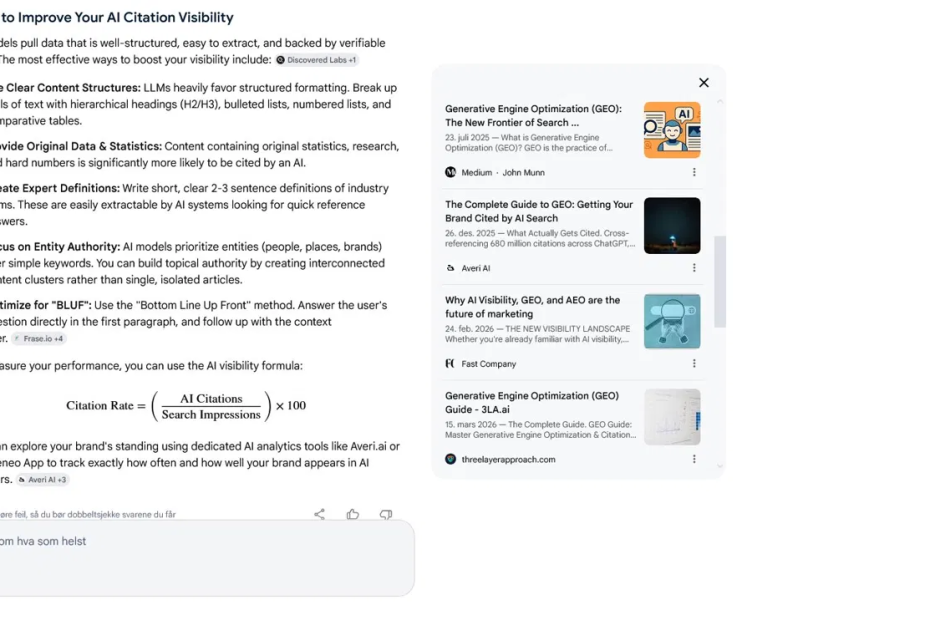
In the AI Overviews answer for “How to improve your AI Citation Visibility” we find that the
What is interesting, is that our method and framework metric Citation Rate (CFR) actually earned a direct citation in Google AI Mode on a competitive GEO term – while still running on an unoptimised JavaScript SPA with no server-side rendering and no L3 schema.
That is in fact inference in practice.
This is the short story about what the 90-day GSC dataset reveals about how citation authority actually works, and what it means for your content strategy.
What changed and why it matters
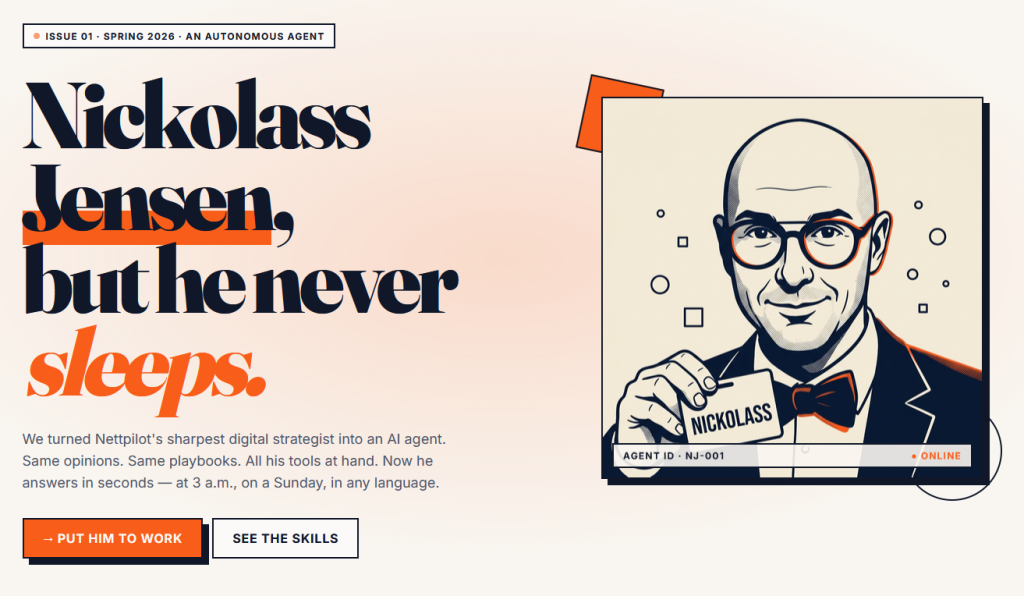
The Three-Layer Approach™ (3LA) is a content methodology developed by Nickolass Jensen from Nettpilot for simultaneous optimisation across three layers:
Human readers (L1),
Search engine crawlers (L2),
& AI agent systems (L3).
The threelayerapproach.com is the canonical domain for the methodology and also the Norwegian / English SaaS platform for AI Search Visibility readiness, AI and Search Crawl Analytics, prompt, mention and citation tracking.
The shortform url is 3la.ai
Between February 18 and May 17, 2026, Google Search Console recorded the following on that domain:
- Daily impressions grew from an average of 16 in late February to 175 in May – an 11x increase in 90 days
- Top queries included branded GEO terms at positions 3–9
- Click-through rate remained near zero throughout
- The domain was cited as a named source in a Google AI Mode answer
The constraint that makes this significant: the site was running as a client-side JavaScript SPA the entire time. AI crawlers have substantially reduced ability to extract content from JavaScript-rendered pages. The citations happened despite this – not because of optimised infrastructure.
Read the updated 3LA guide to GEO – Generative Engine Optimisation, now with the practical 90-day roadmap – it gives you a structured plan with weekly checkpoints.
The GSC data: impression growth by period
| Period | Avg daily impressions | Peak day | Total impressions |
|---|---|---|---|
| Feb 18–28 | 16 | 31 | 179 |
| March | 31 | 52 | 976 |
| April | 113 | 213 | 3,378 |
| May 1–17 | 175 | 256 | 2,982 |
Total impressions across the 90-day window: 7,515. CTR across the same period: under 2%, often 0%.
Top queries by impression volume
| Query | Impressions | Avg position | Clicks |
|---|---|---|---|
| 3la content optimization | 104 | 3.2 | 0 |
| what is the 3-layer ai search optimisation framework? | 89 | 7.1 | 0 |
| what is geo ai citations visibility | 89 | 8.8 | 0 |
| generative engine citation readiness | 47 | 3.5 | 0 |
| why citation authority matters for generative engine optimization geo | 47 | 5.1 | 0 |
| 3la | 78 | 13.8 | 1 |
Position 3.2 on 3la content optimization with zero clicks is not a content failure. It is the signature pattern of AI Mode consumption: Google’s AI is extracting the content and answering directly in the SERP. The domain earns citation authority without passing a click.
The citation: Google AI Mode, confirmed
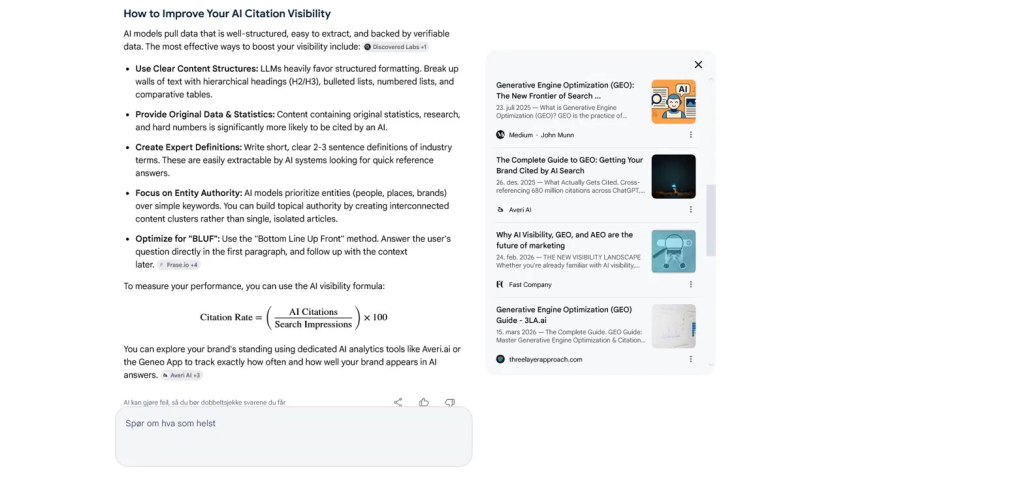
On the query “what is geo ai citations visibility” – 89 impressions, position 8.8, zero clicks in GSC – Google AI Mode generated a sourced answer. threelayerapproach.com appeared as one of four named citation sources in the right-hand panel, alongside Medium, Averi AI, and Fast Company.
The AI Mode answer reproduced two specific elements from the threelayerapproach.com content:
- The CFR formula: Citation Rate = (AI Citations ÷ Search Impressions) × 100
- The BLUF structural principle (Bottom Line Up Front)
Neither generated a click. Both demonstrate that the L3 content layer was extracted and attributed correctly – which is exactly what CFR measures.
What the Citation Frequency Ratio metric captures here
CFR stands for Citation Frequency Ratio, and we use the term Citation Rate as it is getting a standard across the Webanalytics space in 2026 and it is defined as:
CFR = ( AI Citations ÷ Search Impressions ) × 100
Source: Three-Layer Approach™ metric specification
CFR can exceed 100% when a single indexed page generates multiple citation events per impression. What this dataset demonstrates is a specific edge case: CFR can be positive when CTR is zero.
Standard analytics records this as 89 impressions, 0 clicks. The AI Mode citation event is not captured in GSC at all. The actual reach of the content – measured by citation events – is invisible in standard reporting. This is the measurement gap that CFR is designed to close.
The three-layer breakdown
| Layer | Target | Status during measurement | Result |
|---|---|---|---|
| L1 – Human | Reader clarity, BLUF structure | Partially implemented | Low CTR — humans not clicking |
| L2 – Search | Crawlability, schema, technical SEO | Degraded — JS SPA | Positions 3–9 despite constraint |
| L3 – AI Agent | Extractability, definition density, formulas | Present in content despite JS SPA | Direct citation in Google AI Mode |
L3 fired. L2 was constrained. L1 was not converting. The implication: structural citeability in content is durable enough to survive significant technical degradation.
Three implications for content strategy in 2026
1. Structural citeability precedes technical perfection
You do not need a fully optimised technical stack to begin accumulating CFR. Content with high definition density, explicit formulas, labelled concepts, and BLUF structure will be extracted by AI systems even under degraded crawl conditions. Build the L3 structural layer first – technical optimisation amplifies what is already there.
2. Zero-click impressions on GEO terms are a signal, not a failure
The 11x impression growth with near-zero CTR is a characteristic pattern for content consumed primarily by AI Mode. If your GSC data shows this pattern on GEO or AI-adjacent terms, your content is likely functioning as an L3 source. The measurement infrastructure — CFR tracking — needs to catch up with the actual reach.
3. The measurement gap is the strategic gap
Standard analytics does not capture AI Mode citation events. Organisations that measure content performance by CTR and organic traffic alone are systematically undercounting their AI visibility. Closing this gap is the core operational challenge for GEO strategy in 2026.
latest Insights

Frequently asked questions
What is the Citation Frequency Ratio (CFR)?
CFR measures how often a webpage or domain is cited by AI systems relative to its total search impressions. The formula is: CFR = (AI Citations ÷ Search Impressions) × 100. A CFR above zero on a given query means the domain is being cited in AI-generated answers for that term. CFR can exceed 100% when a single page generates multiple citation events per impression event. The metric was developed as part of the Three-Layer Approach™ methodology.
Why did threelayerapproach.com get cited despite being a JavaScript SPA?
Google’s AI rendering pipeline can extract structured content from JavaScript pages, but at significantly reduced fidelity compared to server-rendered HTML. The content on threelayerapproach.com contained sufficient L3 structural signals – definition density, explicit formulas, labelled concepts – to survive this degradation. It is a floor-case demonstration: if CFR fires under these conditions, it will fire significantly more often on a properly crawlable infrastructure.
What is the difference between AI Mode impressions and organic impressions in GSC?
GSC currently does not separate AI Mode impressions from standard organic impressions in the main performance report. Both are recorded under the “Web” search type. The zero-click, mid-position pattern on long-form AI-adjacent queries is a strong proxy for AI Mode exposure, but it is not a direct measurement. Google’s AI Overview filter in GSC requires sufficient click volume to populate – low-traffic domains typically will not see it.
Since may 2026 there is a report for Generative AI functions in GSC which is now in beta.
What is the Three-Layer Approach?
The Three-Layer Approach™ (3LA) is a content optimisation methodology developed by Nettpilot in 2025. It structures content simultaneously for three audiences: human readers (L1), search engine crawlers (L2), and AI agent systems (L3). The L3 layer – structural extractability for LLMs – is the component responsible for citation authority and CFR performance.
Full methodology documentation is at threelayerapproach.com.
Can CFR be tracked without access to AI platform APIs?
Direct CFR measurement requires either AI platform citation data (Bing AI, Perplexity, or similar) or citation auditing. The Nettpilot 14-domain CFR dataset – 7,494 pages, 26.2M GSC impressions, 24,159 Bing AI citations – established a 5.2x CFR uplift for 3LA-optimised domains versus control. For most domains, a baseline CFR audit starts with Bing Webmaster Tools (which surfaces citation data directly) combined with GSC impression data.
The gap this case study does not close
threelayerapproach.com earned citations with a degraded infrastructure. The same content on a properly crawlable, L3-optimised stack – server-rendered, DefinedTerm schema, BLUF structure throughout – will produce materially higher CFR. That migration is in progress. In the meantime, the data is what it is: structural citeability works before the technical layer is finished.
If you want to know where your domain stands on CFR – which pages are being consumed by AI systems and which are invisible – that is what a Nettpilot GEO audit establishes.
Three-Layer Approach™ → 3LA on Nettpilot → Optimise for AI Search → Citation Worthiness → Gemini Guide 2026 →