
Why “Good Content” Is No Longer Enough and How the Three-Layer Approach™ Solves the Problem of Semantic Fragmentation.
This article is also published in Norwegian as Chunk-optimalisering: Slik strukturerer du innhold for AI (Den tekniske guiden)
AI Doesn’t Read—It “Consumes”
In traditional SEO, the goal was to serve a “full meal” to Googlebot. In 2025, with automated traffic now accounting for 51% of all web activity, the rules have changed. Today, optimizing for LLMs (Large Language Models) like ChatGPT, Gemini, and Perplexity is about serving perfect, bite-sized portions. We call this Chunking.
At Nettpilot, through our work with The Three-Layer Approach™ (TLA), we have identified a critical trend: websites that rank at the top of Google can be completely invisible to AI agents. The reason? They fail at Chunk Optimization.
What is a Chunk?
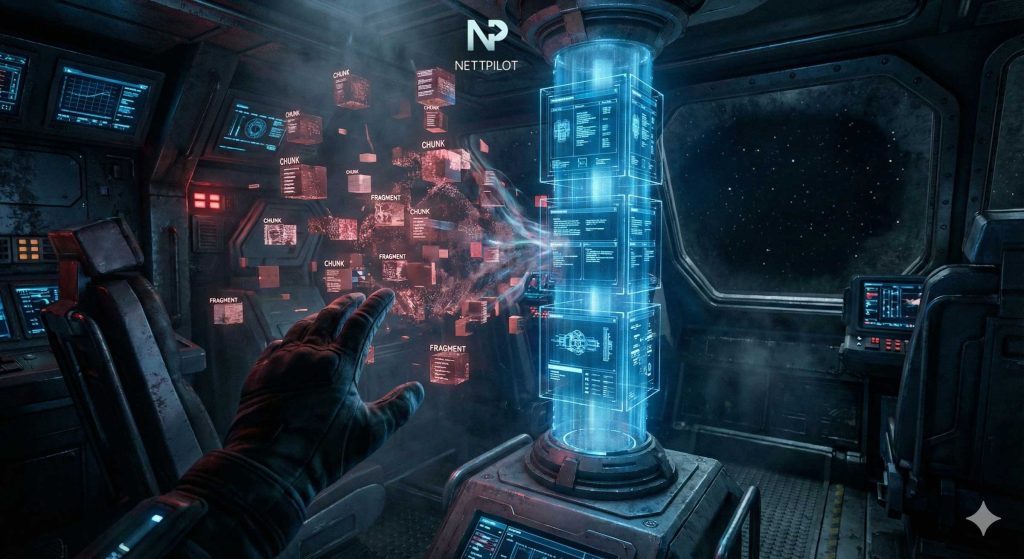
A “chunk” is a semantically self-contained unit of text. To an AI, your article is not a long story; it is a database of vectors.
Most AI systems utilize Retrieval-Augmented Generation (RAG), which combines information retrieval with text generation. When an AI agent scans your page, it breaks the content into chunks (typically 200–500 tokens). If critical information (e.g., your pricing) ends up in one chunk, while the context (what the service actually is) ends up in another, the AI loses the thread. The result? You are not cited.
The Problem: The “Semantic Soup”
Modern marketing often relies on long, flowing narratives. This works for humans (Layer 1 in TLA), but it is catastrophic for machines (Layer 3).
Example of poor chunking:
“When choosing a provider, it is important to consider many factors. Ours is the best because it is fast.”
In this scenario, the AI must guess which provider is being discussed. If this sentence ends up in a chunk without your brand name, it becomes valueless data.
The Solution: Entity-Driven Chunking (The 3LA Method)
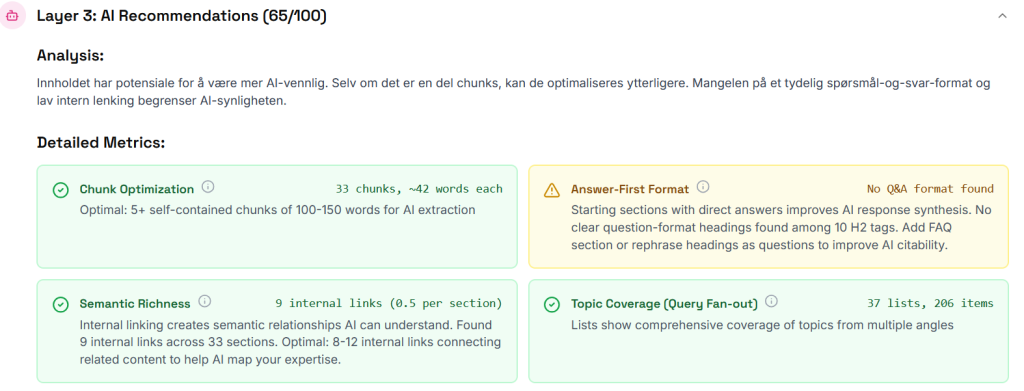
In our AI-Readiness Audit, we measure sites on “Contextual Density”—the core of chunk optimization.
Here is our technical blueprint for fixing this:
1. “The Rule of One” (One Entity per Section)
Ensure that every paragraph or logical section focuses on one primary entity. Do not mix company history with product specifications in the same <p> tag.
- Incorrect: Mixing unrelated facts in one large block of text.
- Correct: Use clear headings followed by specific data points.
2. Semantic “Re-stating”
In the agentic web, nouns are more valuable than pronouns. Instead of writing “It also features…”, write “The IT System also features…”. This ensures that even if the AI slices the text mid-sentence, the “chunk” retains its identity.
3. HTML Structure as “Hints”
AI models use HTML structures to understand where a chunk starts and ends.
- Use
<h2>and<h3>tags as clear “walls” between chunks. - Use lists (
<ul>,<ol>) for facts. Lists are “candy” for AI agents because they represent pre-structured data. - The “Details” Trick: Use
<details>and<summary>tags for FAQs. This provides a clean UX for humans (Layer 1) while remaining fully extractable for AI as First-View Content in the Response HTML.
The Business Impact: Quantifying Invisibility
Ignoring Chunk Optimization is a strategic business risk. For a typical enterprise, the “AI Trust Gap” and poor visibility can lead to an estimated annual revenue loss of 2–4 million NOK (approx. $200k – $400k).
| Layer | Audience | Focus | Requirement |
| Layer 1 | Humans | UX & Engagement | Visual appeal and flow12. |
| Layer 2 | Search Engines | Technical SEO | Indexability and authority13. |
| Layer 3 | AI Agents | Chunking & Entities | First-View Content & citeability14. |
Out Mantra: Future-Proof Your Content
Chunk Optimization is not an isolated tactic; it is the bridge over The Hidden Content Paradox. You cannot sacrifice user experience for robots, which is why the Three-Layer Approach™ is essential. It ensures your content is:
- Engaging for humans.
- Searchable for Google.
- Citeable for AI.
Does your content have what it takes to be cited by ChatGPT?
Nettpilot offers a comprehensive AI Search Reality Audit™ to measure your Citation Frequency Rate (CFR) and optimize your digital architecture for the AI-driven future.