

Google’s official AI guide tells you what to do: create deeper content. It explicitly fails to tell you how to prove you’ve done it machine-readably – or how to achieve visibility across Perplexity, ChatGPT, and Claude simultaneously. Deterministic GEO scoring closes this exact gap. While LLM-graded tools offer shifting, non-reproducible scores, a deterministic approach provides an absolute benchmark and pinpoints the exact technical architectures you need to fix.
Google’s guide is honest – and strategically incomplete
Google has published its first official documentation on optimizing for generative AI features in Search. It is a critical read – not for the advice it dispenses, but for what it explicitly rules out.
Google states that you do not need: llms.txt files, structured data customized for GEO, content “chunking” for machines, or specialized optimization hacks. Their core directive is simple: lean into foundational technical SEO and build surface-defying depth.
That advice is completely accurate for a single platform. Google’s AI Overviews and AI Mode run natively on their own search index. For Google, optimizing for generative search is largely a direct extension of classical SEO.
The digital reality, however, is multi-platform. Four other major AI systems are actively slicing, scraping, and citing your brand – and none of them touch Google’s index. Nick Fox confirmed Google’s reactive playbook at Google Marketing Live: provide the second and third layers of information that high-level AI summaries inevitably drop. What Fox left unaddressed is Perplexity’s extreme recency weighting, ChatGPT’s deep domain authority bias, or Claude’s rigid E-E-A-T and structured answer formatting requirements.
llms.txt file is a primary competitive edge here.Google’s guide optimizes for one column. The Three-Layer Approach (3LA) optimizes for the entire matrix – utilizing an objective measurement framework that works identically regardless of which model processes the query.
The engineering failure of LLM-graded SEO tools
Most platforms in the “AI SEO” category attempt to grade your content by sending your raw text to a language model and asking a subjective question: “Is this text comprehensive?”. This methodology introduces three critical flaws:
- Non-deterministic outcomes: Audit the exact same URL twice and you will receive conflicting scores. The model’s evaluation shifts dynamically based on temperature settings, shifting context windows, and rolling version patches.
- Platform coupling: A score generated via an OpenAI API tells you nothing about how Gemini 3.5 Flash retrieves your data – yet Gemini is the default model driving Google AI Mode.
- Prose over proof: LLMs natively reward confident marketing copy and smooth prose, even when the underlying claims are structurally unverifyable to an automated crawler.
Deterministic scoring removes this volatility. The 3LA framework analyzes code-level structural signals that remain fixed between indexing runs:
Structural Proof Gap (SPG)
How many of your page’s intent-critical claims – pricing, service parameters, local identifiers, FAQs – are explicitly verified via Schema.org markup rather than merely asserted in body copy? An AI inference engine cites what it can verify. SPG measures that verification gap directly.
Consistency & Redundancy Gap (CRG)
Is the same core fact anchored across independent elements – such as raw body copy, a semantic HTML table, and a JSON-LD block? For a machine, data redundancy equals trust. CRG quantifies how single-sourced, and therefore fragile, your digital information is.
Google’s guide tells you to create deep content. SPG and CRG tell you whether a machine is physically capable of parsing and trusting it. Those are entirely different challenges.
Gemini 3.5 Flash: Validating the three-layer model
The architecture of Gemini 3.5 Flash has fundamentally altered content visibility rules:
- L1
The extraction challenge: Flash’s 1-million token context window allows it to digest massive content stacks. Nick Fox’s advice to go “levels deeper” is now computationally viable – but only if that depth is structured for immediate machine extraction, not linear human reading.
- L2
Infrastructure as load-bearing architecture: Despite Google’s “not required” public stance, Lighthouse now actively scans for the presence of
llms.txt. Gemini’s agentic crawlers traverse site frameworks systematically; canonical hygiene and automated context files are no longer optional. - L3
Entity precision scales with capability: Advanced reasoning engines isolate distinct entities with surgical precision. Your semantic signals – author Person schema,
sameAscorroboration, andknowsAboutconnections – directly dictate your presence or exclusion in the final citation set.
We verified this algorithmically. Our live Gemini 3.5 Flash visibility brief was engineered strictly using 3LA principles. It secured a direct citation placement in Google AI Overviews for “Gemini 3.5 visibility” within 24 hours of execution. While this represents a single case study, it confirms the core technical thesis: deterministic structure beats descriptive content polish every single time.
Our live Gemini 3.5 Flash visibility brief was engineered strictly using 3LA principles. It secured a direct citation placement in Google AI Overviews for “Gemini 3.5 visibility” within 24 hours of execution.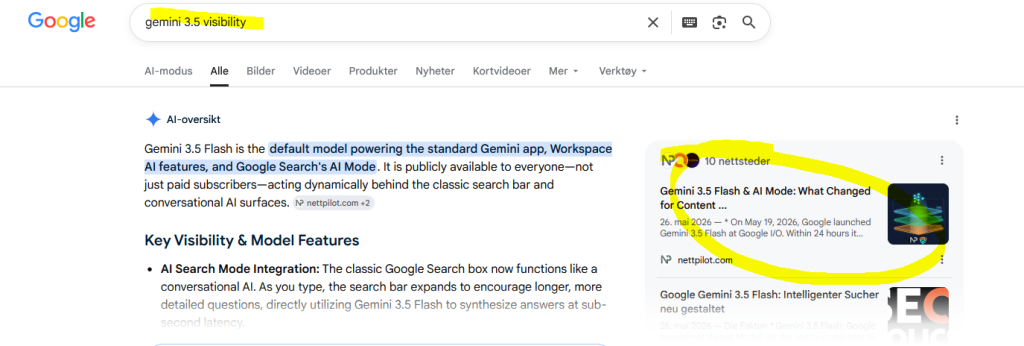
Trust the process: Get you free 3LA Audit in less than 45 seconds >>
The broader perspective and reality Google’s documentation avoids. The Google AI Blind Spot.
Google’s documentation is scoped explicitly for Google. While they dismiss llms.txt as irrelevant to core search, their own developer suite (Lighthouse) checks for it. The contradiction is revealing: Google tracks the non-Google ecosystem with high precision while maintaining official neutrality.
For brands that require simultaneous citation visibility across ChatGPT, Perplexity, Claude, and Google AI Mode, optimizing for a single algorithm is a structural risk. The winning playbook requires building the unified technical architecture all search and AI engines demand: verified entity linkages, redundant fact-grounding, explicit author attribution, and clean, machine-readable text paths.
| Signal | Google AI Mode | Perplexity | ChatGPT | Claude |
|---|---|---|---|---|
| llms.txt | Not required | High Value | Indirect | High Value |
| Structured Data (JSON-LD) | Recommended | Moderate | Moderate | High Value |
| Author Entity (Person Schema) | E-E-A-T Utility | Source Validation | Authority Proxy | Critical Trust Factor |
| Content Depth | Critical (Nick Fox) | Recency + Depth | Comprehensiveness | Structured Facts |
| 3LA Standard Coverage | ✓ | ✓ | ✓ | ✓ |
Monday morning execution roadmap
The strategic framework remains firm, but the deployment of Gemini 3.5 Flash makes immediate technical adjustment mandatory:
- Execute a 3LA LayerScore Audit on your highest-impression, lowest-CTR pages. These are your Dark Opportunities – content that ranks in old search blocks but remains invisible to AI synthesis.
- Tilt your Structural Proof Gap (SPG) first. Isolate your high-value business claims that lack markup and map them cleanly into JSON-LD nodes. This is your single highest-leverage action across all engine architectures.
- Anchor your personal brand entity. Deploy a comprehensive Person schema equipped with explicit
@id,sameAs, andknowsAboutvalues to solidify E-E-A-T across all four platforms at once. - Deploy and maintain a root
llms.txtpathway. Google does not mandate it, but Claude and Perplexity rely on it for structural context. The Nettpilot AI Context Engine automates this natively within WordPress. - Build depth, as demanded by Nick Fox – but break that depth down into isolated Atomic Content Units (ACUs). Ensure engines can extract single factual blocks seamlessly instead of forcing them to analyze unstructured text strings.