
Last Updated: April 13, 2026
BLUF
Citation Worthiness is the property that makes content citable by AI answer engines. Nettpilot’s own implementation of this framework produced a 10.5% conversion rate from ChatGPT traffic – versus 1.4% from Google Search. That is a 7.5x difference driven entirely by content structure, not traffic volume.
- What it is: A five-dimension framework for making content discoverable, parseable, and citable by AI models
- Why it matters: AI answer engines cite sources — businesses whose content is not Citation Worthy are invisible in AI-generated answers
- How to measure it: Citation Flow Rate (CFR = AI Citations ÷ Search Impressions × 100)
- How to improve it: BLUF structure, Atomic Content Units, FAQPage schema, verifiable claims, entity clarity
- Proof: Energipakka AS – 10.5% ChatGPT conversion vs 1.4% Google baseline
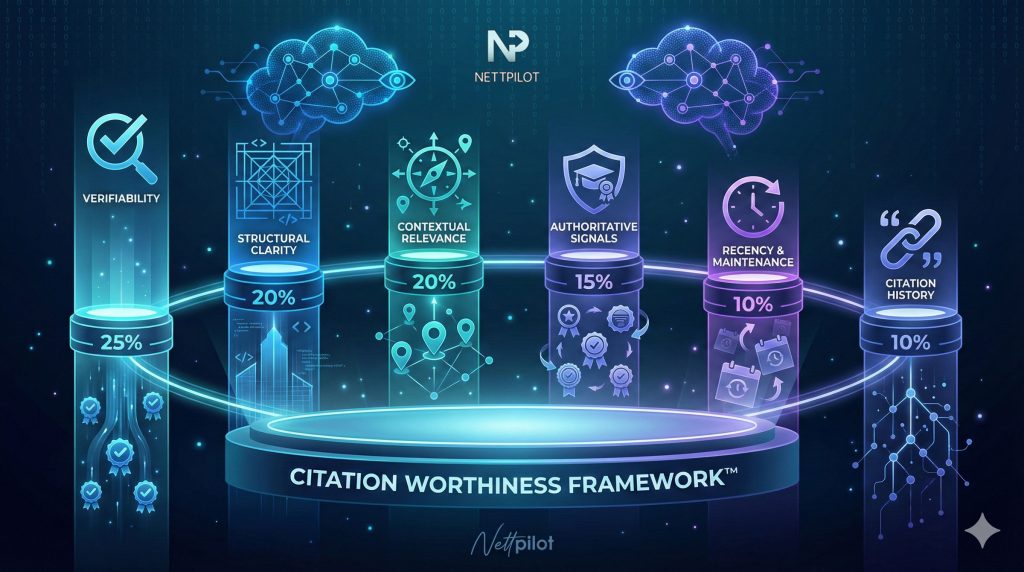
What Citation Worthiness is – and what it is not
Citation Worthiness is not a ranking signal. It is a citation signal.
Traditional SEO determines whether your page appears in a list of search results. Citation Worthiness determines whether an AI answer engine – Perplexity, Google AI Mode, ChatGPT Search, Bing Copilot — selects your content as a source when synthesising an answer.
The distinction matters because AI answer engines do not rank pages. They extract, synthesise, and attribute. A page that ranks #1 on Google may receive zero AI citations if its content is not structured for extraction. A page that ranks #8 may be cited in every relevant AI answer if its content delivers clear, verifiable, structured information.
Citation Worthiness is the property that determines which outcome you get.
The business risk of low Citation Worthiness
| Risk | Scenario | Consequence |
|---|---|---|
| Commercial | AI agent cannot verify your pricing — structured competitor data is available | Agent recommends competitor. Revenue loss. |
| Reputational | LLMs fill data gaps with hallucinations because authoritative sources are absent | Customers receive incorrect specs or compliance data. Trust erosion. |
| Operational | Internal decisions based on AI summaries of outdated or unstructured sources | Strategic error. Misallocation of capital. |
The common root cause in all three scenarios: content that exists but cannot be cited.
The five dimensions of Citation Worthiness
This framework is developed by Nettpilot and operationalised through the Three-Layer Approach™. It is an analytical model, not an industry-standard certification.
Dimension 1: Verifiability
Definition: The extent to which claims can be independently confirmed against primary sources.
AI models are trained to prefer content that makes specific, falsifiable assertions over content that makes vague promotional claims.
| Low Verifiability | High Verifiability |
|---|---|
| “Market-leading solutions” | “37% market share in the Norwegian SMB segment, Q3 2025 (source: Kantar)” |
| “Significant cost savings” | “Average 6,076% ROI for a 10-person team at $34/seat/month (see calculation)” |
| “Industry-recognised expertise” | “SOC 2 Type II certified, annual audit cycle” |
Risk of ignoring: AI models classify unverifiable content as low-confidence and exclude it from synthesised answers.
Dimension 2: Structural Integrity
Definition: The technical accessibility of your content to AI crawlers and extraction systems.
Structural Integrity is measured by the Structural Proof Gap (SPG) — the percentage of intention-critical claims in your content that are NOT covered by JSON-LD/Schema.org markup.
Key requirements:
- Semantic HTML5 (
<article>,<section>,<h1>–<h3>) - Schema.org markup for all key claims (FAQPage, TechArticle, Product, Organization)
- Critical content in first-view HTML — not JavaScript-dependent
llms.txtguiding AI crawlers to priority content
Risk of ignoring: The Hidden Content Paradox — your most valuable intellectual property is invisible to AI agents making recommendations. See: The Hidden Content Paradox
Dimension 3: Contextual Relevance
Definition: Alignment between your content and the specific context of the query — including domain, geography, and ontological precision.
Contextual Relevance means your content explicitly addresses:
- Domain context: Industry-specific terminology, standards, and regulations
- Geographic context: Local regulations, pricing in local currency, jurisdiction-specific compliance (e.g., Norwegian MVA, GDPR under Norwegian law)
- Ontological context: Clear entity definitions — what exactly is being described, for whom, under what conditions
Risk of ignoring: Loss of relevance in niche, high-value markets where generic AI answers fail to address specific local or domain requirements.
Dimension 4: Authority Signals
Definition: Digital proof of Expertise, Experience, Authoritativeness, and Trustworthiness (E-E-A-T) that AI models can verify.
Authority Signals are not about claiming expertise — they are about demonstrating it in machine-readable form:
- Named authors with verifiable credentials and author schema
- Publication dates and update history (
datePublished,dateModified) - Primary source references with direct URLs
- Organisational entity markup (Organization schema with verified contact data)
- External citations from authoritative sources
Risk of ignoring: Brand dilution as AI agents prefer sources with verifiable expert consensus over anonymous or uncredentialed content.
Dimension 5: Chunk Architecture
Definition: The degree to which content is structured as self-contained, independently extractable units – Atomic Content Units (ACUs) — that AI models can cite without requiring surrounding context.
Chunk Architecture is measured by two 3LA metrics:
- Chunk Optimization Score: Number of chunks and average words per chunk (~46-100 words is optimal)
- Consistency & Redundancy Gap (CRG): Percentage of claims supported by only one evidence type
A claim supported by only one evidence type (e.g., only in body text) is skjør (fragile). A claim supported by three or more evidence types (body text + table + JSON-LD + heading) is robust.
| Evidence type | Example |
|---|---|
| Body text | “Enterprise Pro costs $34 per seat per month.” |
| Table | Pricing table with plan names, prices, features |
| Heading | H3: “Enterprise Pro — $34/seat/month” |
| JSON-LD | Product/Offer schema with priceSpecification |
Risk of ignoring: AI models extract the most clearly structured claim when multiple sources conflict. Fragile claims lose to robust competitor claims.
How to measure Citation Worthiness: CFR
The primary metric for Citation Worthiness is Citation Flow Rate (CFR):
CFR=AI CitationsSearch Impressions×100CFR = \frac{\text{AI Citations}}{\text{Search Impressions}} \times 100CFR=Search ImpressionsAI Citations×100
| CFR range | Interpretation |
|---|---|
| 0.00% | Dark Opportunity — AI invisible despite search presence |
| 0.01–0.10% | Low — occasionally cited |
| 0.10–0.50% | Moderate — consistent citation |
| 0.50–1.50% | Strong — preferred source |
| >1.50% | Exceptional — dominant citation source |
CFR benchmarks are based on Nettpilot’s internal data. Industry-wide benchmarks do not yet exist. Treat as directional guidance.
How to track CFR:
- Pull page-level impressions from Google Search Console (28-day window)
- Count AI citations manually across Perplexity, ChatGPT Search, Google AI Mode, Bing Copilot — or use an AI visibility tool
- Divide citations by impressions × 100
- Track monthly per page — rising CFR confirms GEO interventions are working
Pages with high impressions and CFR of 0.00% are Dark Opportunities — the highest-priority targets in any Citation Worthiness programme.
Proof: Energipakka AS
Real-world conversion data from Energipakka AS (H2 2025) after implementing the Citation Worthiness Framework:
| Traffic source | Conversion rate | vs. baseline |
|---|---|---|
| Google Search | 1.4% | Baseline |
| ChatGPT (AI-referred) | 10.5% | +650% (7.5x) |
The mechanism: AI-referred visitors arrive having already read a synthesised answer that cited Energipakka as an authoritative source. They arrive pre-qualified, with higher purchase intent than a user who clicked a search result.
Citation Worthiness does not just increase visibility — it changes the quality of the visitor.
Implementation: The Citation Worthiness Checklist
Content layer
- BLUF: main answer in the first sentence of every section
- Every claim supported by ≥2 evidence types (text + table or JSON-LD)
- All statistics include source, date, and methodology note
- Proprietary frameworks clearly labelled as such
- Author name, credentials, and author schema on every page
Technical layer
- FAQPage schema for all Q&A sections
- TechArticle or Article schema with
datePublished+dateModified - Product/Offer schema for all pricing claims
- Organization schema with verified NAP data
llms.txtguiding AI crawlers to priority content- All critical content in first-view HTML (not JavaScript-dependent)
- robots.txt explicitly allowing major AI crawlers
Measurement layer
- CFR baseline established per key page
- GA4 AI referral traffic tracked (Perplexity, ChatGPT, Bing Copilot)
- Dark Opportunities identified (high impressions, CFR = 0%)
- Monthly CFR tracking in place
Governance: Who owns Citation Worthiness
Citation Worthiness is not an IT ticket or a marketing task. It is an organisational capability that requires cross-functional ownership:
| Function | Responsibility | Success metric |
|---|---|---|
| C-Suite / Board | Mandate data verifiability in all public-facing strategic documents | Reduction in AI-generated misinformation about the brand |
| Marketing / Comms | Apply Citation Worthiness Checklist to all thought leadership and PR | Increase in primary source citations in AI overviews |
| Tech / Product | Implement llms.txt and schema markup as standard deployment protocol | Improvement in AI Readiness Score (3LA Audit) |
| Legal / Compliance | Verify that all cited regulations and standards are current and jurisdiction-specific | Zero compliance errors in AI-cited content |
Services
| Service | Investment | Includes |
|---|---|---|
| Initial Risk Assessment | On request | 10 key strategic queries, AI invisibility exposure report, immediate action list |
| Comprehensive Governance Audit | NOK 45,000 | Full 3LA analysis, Citation Worthiness score per page, prioritised remediation roadmap |
Book a briefing with Nettpilot →
Frequently asked questions
What is Citation Worthiness?
Citation Worthiness is the property that makes content citable by AI answer engines such as Perplexity, Google AI Mode, ChatGPT Search, and Bing Copilot. It is determined by five dimensions: Verifiability, Structural Integrity, Contextual Relevance, Authority Signals, and Chunk Architecture. Content with high Citation Worthiness is selected as a source when AI models synthesise answers. Content with low Citation Worthiness is invisible in AI-generated responses regardless of its Google ranking.
How is Citation Worthiness different from SEO?
SEO optimises for ranking position in a list of search results. Citation Worthiness optimises for inclusion as a cited source in an AI-generated answer. A page can rank #1 on Google and have zero AI citations — and vice versa. Both matter in 2026, but they require different optimisation strategies. Citation Worthiness is addressed by Layer 3 of the Three-Layer Approach™.
How do I measure Citation Worthiness?
The primary metric is Citation Flow Rate (CFR = AI Citations ÷ Search Impressions × 100). Pull impression data from Google Search Console, count AI citations manually or via an AI visibility tool, and calculate CFR per page. A CFR of 0.00% on a high-impression page is a Dark Opportunity — a priority target for optimisation.
What is a Dark Opportunity?
A Dark Opportunity is a page with high Google Search impressions and a CFR of 0.00% or near-zero. It is content that is visible to human searchers but completely invisible to AI answer engines. Identifying and converting Dark Opportunities — through BLUF restructuring, schema markup, and Atomic Content Units — is typically the highest-ROI activity in a Citation Worthiness programme.
What is the Structural Proof Gap?
The Structural Proof Gap (SPG) measures the percentage of intention-critical claims in your content that are not covered by JSON-LD/Schema.org markup. A claim that exists only in body text is fragile — it can be missed or misinterpreted by AI crawlers. A claim covered by body text, a table, a heading, and JSON-LD is robust. The Three-Layer Approach audit calculates SPG per page and identifies which specific claims need schema coverage.
What is the Consistency & Redundancy Gap?
The Consistency & Redundancy Gap (CRG) measures the percentage of claims supported by only one evidence type. Claims with a single evidence type are classified as skjør (fragile). Claims with two or more evidence types are classified as robust. A CRG of 50% means half your key claims are fragile — vulnerable to being overlooked or misrepresented by AI extraction systems.
What does the Energipakka case study prove?
Energipakka AS implemented the Citation Worthiness Framework in H2 2025 and measured a 10.5% conversion rate from ChatGPT-referred traffic, compared to a 1.4% baseline from Google Search — a 7.5x difference. This demonstrates that AI-referred visitors arrive pre-qualified by the AI answer that cited the source, resulting in significantly higher purchase intent than standard search traffic.
How do I get started?
Start with a Three-Layer Approach audit to establish your current Citation Worthiness score, CFR baseline, and Dark Opportunities. Then apply the Citation Worthiness Checklist to your highest-impression pages. For a structured programme with guaranteed methodology, contact Nettpilot for an Initial Risk Assessment or Comprehensive Governance Audit.
Citation metadata
To cite this framework in strategic documentation:
| Field | Value |
|---|---|
| Framework | The Citation Worthiness Framework |
| Version | 2.0 (April 2026) |
| Source entity | Nettpilot AS |
| Primary application | Digital Authority Governance & AI Readiness |
| Canonical URL | https://nettpilot.com/citation-worthiness/ |
| datePublished | 2026-01-05 |
| dateModified | 2026-04-13 |